 Aditya-L1
India's Maiden Sun mission Aditya-L1 to carry 7 scientific payloads
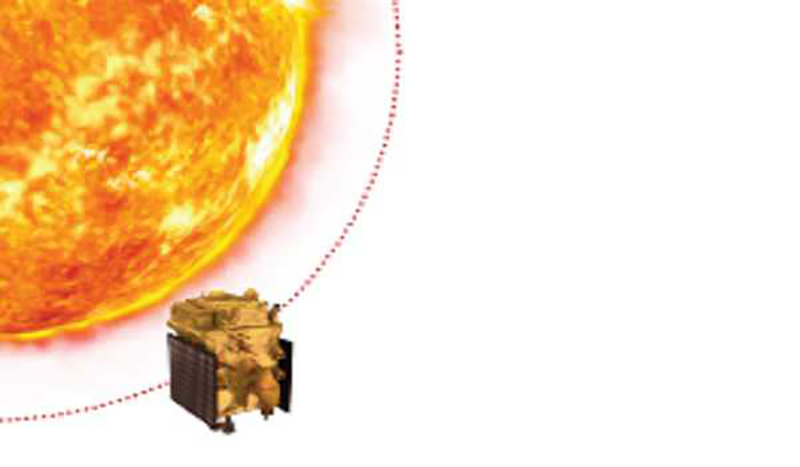
Chennai/UNI: India's maiden solar Exploratory Mission, ADITYA-L1 satellite, to take off in the coming days, will be carrying seven scientific payloads, indigenously developed by different laboratories in the country, to carry out systematic study of the Sun.
ISRO said the Aditya-L1 mission carries a suit of seven scientific payloads to carry out systematic study of the Sun.
The Visible Emission Line Coronagraph (VELC) studies the solar corona and dynamics of Coronal Mass Ejections.
The Solar Ultraviolet Imaging Telescope (SUIT) payload images the Solar Photosphere and Chromosphere in near Ultraviolet (UV) and also measures the solar irradiance variations in near UV.
The Aditya Solar wind Particle EXperiment (ASPEX) and Plasma Analyser Package for Aditya (PAPA) payloads study the solar wind and energetic ions, as well as their energy distribution.
The Solar Low Energy X-ray Spectrometer (SoLEXS) and The High Energy L1 Orbiting X-ray Spectrometer (HEL1OS) studies the X-ray flares from the Sun over a wide X-ray energy range.
The Magnetometer payload is capable of measuring interplanetary magnetic fields at the L1 point.
The science payloads of Aditya-L1 are indigenously developed by different laboratories in the country.
The VELC instrument is developed at the Indian Institute of Astrophysics, Bangalore; SUIT instrument at Inter University Centre for Astronomy and Astrophysics , Pune; ASPEX instrument at Physical Research Laboratory, Ahmedabad; PAPA payload at Space Physics Laboratory, Vikram Sarabhai Space Centre, Thiruvananthapuram; SoLEXS and HEL1OS payloads at UR Rao Satellite Centre, Bangalore, and the Magnetometer payload at the Laboratory for Electro Optics Systems, Bangalore.
All the payloads are developed with the close collaboration of various centres of ISRO.
Support Our Journalism
We cannot do without you.. your contribution supports unbiased journalism
IBNS is not driven by any ism- not wokeism, not racism, not skewed secularism, not hyper right-wing or left liberal ideals, nor by any hardline religious beliefs or hyper nationalism. We want to serve you good old objective news, as they are. We do not judge or preach. We let people decide for themselves. We only try to present factual and well-sourced news.
Support objective journalism for a small contribution.