India rejects US Commission’s call to label it ‘religious freedom violator’, slams report as biased
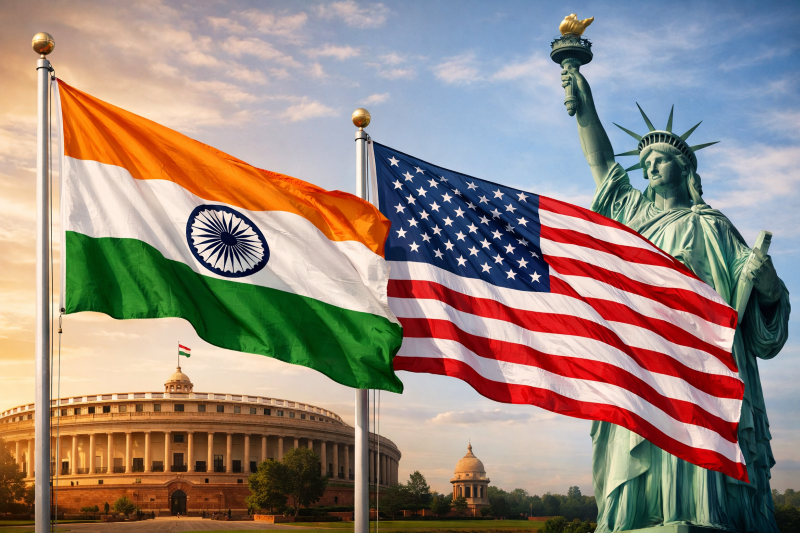
India on Monday strongly rejected recommendations by a United States federal government commission that called for the country to be designated a “Country of Particular Concern” (CPC) over alleged religious freedom violations and proposed targeted sanctions against India’s external intelligence agency and a prominent socio-cultural organisation.
Responding to the report, Ministry of External Affairs spokesperson Randhir Jaiswal said India categorically rejects the characterisation made by the United States Commission on International Religious Freedom (USCIRF).
“We have taken note of the latest report of USCIRF. We categorically reject its motivated and biased characterisation of India. For several years now, USCIRF has persisted in presenting a distorted and selective picture of India, relying on questionable sources and ideological narratives rather than objective facts,” Jaiswal said.
He added that such repeated misrepresentations undermine the credibility of the commission itself.
Jaiswal also urged the panel to focus on issues within the United States, pointing to incidents of vandalism and attacks on Hindu temples and what he described as growing intolerance and intimidation faced by members of the Indian diaspora.
The USCIRF made the recommendations in its 2026 Annual Report, which evaluates global religious freedom conditions during 2025.
The report urged the US government to designate India as a “Country of Particular Concern”, a classification used for nations accused of engaging in or tolerating severe violations of religious freedom.
The commission also proposed targeted sanctions against India’s external intelligence agency, Research and Analysis Wing (R&AW), and the Rashtriya Swayamsevak Sangh (RSS).
It suggested measures such as freezing assets and restricting entry into the United States for individuals or entities allegedly responsible for violations.
In addition, the report recommended linking future US security assistance and bilateral trade engagement with India to improvements in religious freedom.
The commission also called on the US Congress to reintroduce and pass the Transnational Repression
Reporting Act of 2024, which would mandate annual reporting on alleged acts of transnational repression by the Indian government targeting religious minorities in the United States.
In its assessment, the USCIRF claimed that religious freedom conditions in India continued to deteriorate in 2025, citing new legislation and actions that it said targeted religious minorities and their places of worship.
The report also pointed to efforts by several Indian states to introduce or strengthen anti-conversion laws, including provisions for stricter prison sentences.
India has repeatedly rejected such assessments in the past, describing them as biased and based on selective narratives.
Support Our Journalism
We cannot do without you.. your contribution supports unbiased journalism
IBNS is not driven by any ism- not wokeism, not racism, not skewed secularism, not hyper right-wing or left liberal ideals, nor by any hardline religious beliefs or hyper nationalism. We want to serve you good old objective news, as they are. We do not judge or preach. We let people decide for themselves. We only try to present factual and well-sourced news.
Support objective journalism for a small contribution.