India rejects UNHRC report on Kashmir, says it is motivated
New Delhi, June 14 (IBNS): As a report by the United Nations Human Rights Office called for addressing "human rights violations and abuses" in Kashmir, India on Thursday sharply reacted, describing it as "fallacious, tendentious and motivated."
In response to a question on the Report by the Office of the High Commissioner for Human Rights on “The human rights situation in Kashmir”, the official spokesperson of the Ministry of External Affairs said India rejects the report, which "is a selective compilation of largely unverified information.
"It is overtly prejudiced and seeks to build a false narrative," the MEA said.
It said the UNHRC report violates India’s sovereignty and territorial integrity.
"The entire state of Jammu and Kashmir is an integral part of India. Pakistan is in the illegal and forcible occupation of a part of the Indian state through aggression. We have repeatedly called upon Pakistan to vacate the occupied territories. The incorrect description of Indian territory in the report is mischievous, misleading and unacceptable," the MEA said.
India's reaction came after a 49-page report – the first ever issued by the UN on the human rights situation in Indian-Administered and Pakistan-Administered Kashmir – was published on Thursday, detailing human rights violations and abuses on both sides of the Line of Control, and highlighting "a situation of chronic impunity for violations committed by security forces."
The report says, " there is an urgent need to address past and ongoing human rights violations and abuses and deliver justice for all people in Kashmir, who for seven decades have suffered a conflict that has claimed or ruined numerous lives."
“The political dimensions of the dispute between India and Pakistan have long been centre-stage, but this is not a conflict frozen in time. It is a conflict that has robbed millions of their basic human rights, and continues to this day to inflict untold suffering,” said UN High Commissioner for Human Rights Zeid Ra’ad Al Hussein.
Zeid said, “It is also why I will be urging the UN Human Rights Council to consider establishing a commission of inquiry to conduct a comprehensive independent international investigation into allegations of human rights violations in Kashmir."
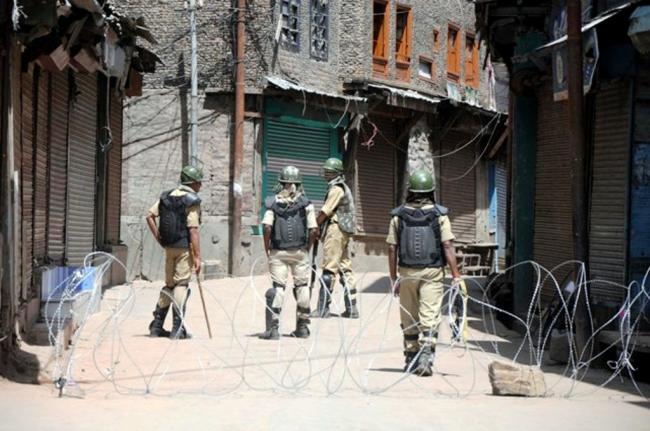
Noting the "continuing serious tensions" in recent weeks, including those stemming from a series of incidents in Srinagar, he called on Indian security forces to exercise maximum restraint, and strictly abide by international standards governing the use of force when dealing with future protests.
"It is essential the Indian authorities take immediate and effective steps to avoid a repetition of the numerous examples of excessive use of force by security forces in Kashmir,” Zeid said.
“Impunity for human rights violations and lack of access to justice are key human rights challenges in the state of Jammu and Kashmir,” the report says, noting that the Armed Forces (Jammu and Kashmir) Special Powers Act 1990 (AFSPA) and the Jammu and Kashmir Public Safety Act 1978 (PSA) have “created structures that obstruct the normal course of law, impede accountability and jeopardize the right to remedy for victims of human rights violations.”
However, India pointed out that terrorism is the " most egregious violation of human rights."
MEA said the report is "motivated" and it "deliberately ignores" that fundamental rights and freedoms guaranteed under the Constitution to every Indian citizen, including in the state of Jammu & Kashmir, are protected also by an independent judiciary, human rights commissions, free and vibrant media and an active civil society.
" Yet the authors have conveniently ignored the pattern of cross-border terrorism emanating from Pakistan and territories under its illegal control. Cross-border terror and incitement are aimed at suppressing the will of the people of Jammu and Kashmir, disrupting its political and social fabric and undermining India’s integrity," the MEA said.
"It is disturbing that those behind this report have chosen to describe internationally designated and UN-proscribed terrorist entities as “armed groups” and terrorists as “leaders”. This undermines the UN-led consensus on zero tolerance to terrorism," it said.
"Our protest and views in the matter have been conveyed unequivocally to the Office of the High Commissioner for Human Rights. We are deeply concerned that individual prejudices are being allowed to undermine the credibility of a UN institution."
"Such malicious reports cannot undermine the will of the people and the Government of India to take all measures necessary to protect the sovereignty and territorial integrity of the country from cross-border terrorism," MEA said.
Support Our Journalism
We cannot do without you.. your contribution supports unbiased journalism
IBNS is not driven by any ism- not wokeism, not racism, not skewed secularism, not hyper right-wing or left liberal ideals, nor by any hardline religious beliefs or hyper nationalism. We want to serve you good old objective news, as they are. We do not judge or preach. We let people decide for themselves. We only try to present factual and well-sourced news.
Support objective journalism for a small contribution.