I feel the Indian economy is doing badly, but don't know what can be done: Nobel in Economics winner Abhijit Banerjee
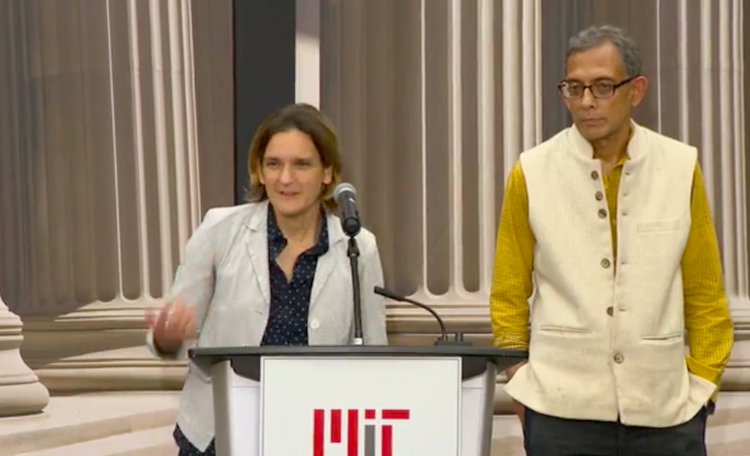
Boston: Indian-American economist Abhijit Banerjee, who along with his wife Esther Duflo and Michael Kreme, jointly won the Nobel Prize in Economics on Monday “for their experimental approach to alleviating global poverty”, said he thinks that the Indian economy is at the moment doing very badly and the money should go to the poor for its revival though he has no clear prescription for its correction.
"I feel the economy is doing very badly. One of the numbers that came out (National Sample Survey) gives you average consumption in urban and rural India. That has slightly gone down, that has happened first time in many, many, many years," he told a news conference at Massachusetts Institute of Technology (MIT) here along with his wife and co-winner of the Sveriges Riksbank Prize in Economic Sciences in memory of Alfred Nobel.
Known as a critic of the Modi government's economic policy, he said that the NSS data is a sign. He said though the government views all data that are inconvenient for them as wrong, it (Indian government) is increasingly recognising that there is a problem.
Asked what is the solution, he said: "I do not know what can be done. But all I can say is.... the economy has to have more money and poor must have more money. The government has a large deficit but it is aiming to please everybody."
He said the economy is going in a tailspin and the government must worry about demand.
To a question on being the sixth Nobel laureate from Kolkata, he said in a lighter vein that he thinks that those who won before are much more distinguished than him.
He said the award was a recognition and wonderful because it will help a movement in which they believe.
"I think it is still going to be wonderful for the movement that this prize was given," he said adding that it will hopefully bring the message of policy based actions.
"The governments are free not to use our experience," he said, adding that the evidence they have is valuable and now many know that "we know something that might be useful."
"We are excited about what we are doing. It is fun and we are learning," he said.
This will open more opportunities to do more inventive things, added Banerjee who became the second Indian after Amartya Sen to win the Nobel prize in Economics. Sen, with whom he has close relations, had won it in 1998.
Banerjee was born in Mumbai and attended South Point School and Presidency College in Kolkata.
Later, he completed his M.A. in economics at the Jawaharlal Nehru University, Delhi in 1983.
He went on to obtain a Ph.D. in economics at Harvard in 1988.
Support Our Journalism
We cannot do without you.. your contribution supports unbiased journalism
IBNS is not driven by any ism- not wokeism, not racism, not skewed secularism, not hyper right-wing or left liberal ideals, nor by any hardline religious beliefs or hyper nationalism. We want to serve you good old objective news, as they are. We do not judge or preach. We let people decide for themselves. We only try to present factual and well-sourced news.
Support objective journalism for a small contribution.