October 23, 2026 10:12 am (IST)

Follow us:


 BJP
BJP
From Rajbanshis to Matuas, women power to Jangalmahal: BJP’s Bengal swearing-in sends calculated political message
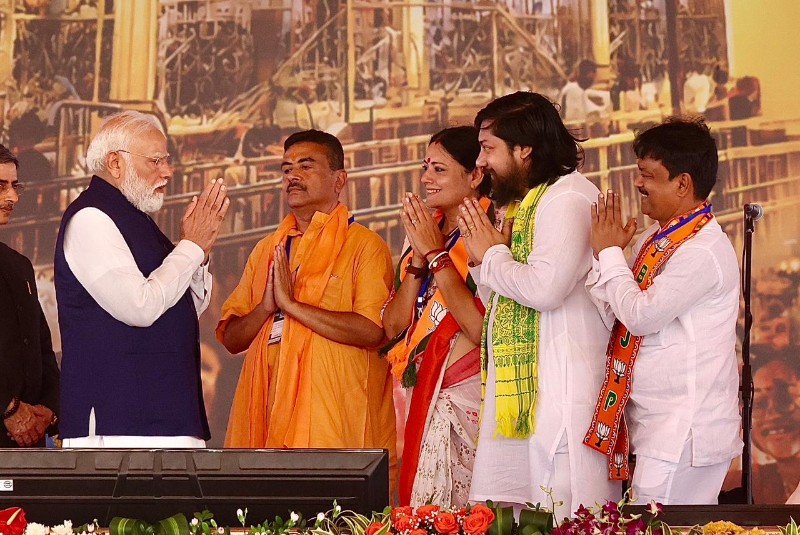
Kolkata/IBNS: The Bharatiya Janata Party (BJP) utilised Suvendu Adhikari’s swearing-in ceremony not only to mark its historic rise to power in West Bengal, but also to send a carefully crafted political message across the state’s key social and regional blocs.
From north Bengal’s Rajbanshi belt to the Matua-dominated border districts, from the tribal strongholds of Jangalmahal to women-centric political messaging, the BJP’s ministerial selections reflected a broader electoral strategy aimed at consolidating its newly built support base in Bengal.
The inclusion of five prominent MLAs in the new Cabinet highlighted how the party balanced ideological loyalty, organisational contribution, caste representation, regional influence and women leadership during the formation of the state government under chief minister Suvendu Adhikari.
Dilip Ghosh
Senior BJP leader Dilip Ghosh emerged as one of the most significant figures during the swearing-in process and is widely seen as a strong contender for the deputy chief minister’s post.
Coming from a Rashtriya Swayamsevak Sangh (RSS) background, Ghosh played a central role in building the BJP’s organisational network in West Bengal during a period when the party had little electoral presence in the state.
He was among the BJP’s three victorious MLAs in the 2016 Assembly elections, long before the party became a major political force in Bengal.
Under his leadership as state BJP president, the party registered a dramatic rise in the 2019 Lok Sabha elections, winning 18 out of 42 parliamentary seats in West Bengal with a vote share of 40.25 percent.
Party leaders often credit Ghosh with transforming the BJP from a marginal player into a serious challenger to the Trinamool Congress in Bengal politics.
Agnimitra Paul
The elevation of Agnimitra Paul carried both political and symbolic significance for the BJP.
A well-known fashion designer before entering politics, Paul joined the BJP in 2019 and won the Asansol Dakshin Assembly seat in 2021.
Despite electoral setbacks for the party in subsequent parliamentary contests, she retained her political relevance and secured re-election from the constituency in 2026.
She is now being viewed as a likely candidate for the second deputy chief minister’s position.
Her rise comes at a time when the BJP is aggressively projecting issues related to women’s representation and women’s safety, both in West Bengal and nationally.
Paul also represents the industrial belt of Asansol, a region seen as strategically important for the BJP’s economic and development narrative in the state.
Kshudiram Tudu
The induction of Kshudiram Tudu into the Cabinet underscored the BJP’s continued focus on tribal outreach, especially in the Jangalmahal region.
Tudu, a tribal leader, won the Ranibandh Assembly seat in Bankura district by a margin of nearly 52,000 votes.
Over recent years, the BJP has steadily expanded its influence among tribal communities in both north and south Bengal.
The party’s decision to include Tudu in the Cabinet is being viewed as a direct political message to the tribal population of the state.
Jangalmahal, once considered a difficult terrain for the BJP, has increasingly emerged as a politically significant zone for the saffron party.
Ashok Kirtania
Ashok Kirtania’s inclusion in the Cabinet reflected the BJP’s continued emphasis on the influential Matua community.
Kirtania, who won from Bongaon near the India-Bangladesh border, belongs to the Matua community, many of whose members migrated from the erstwhile East Pakistan and present-day Bangladesh.
Citizenship has remained a major issue within the community for decades.
The BJP has repeatedly highlighted the Citizenship Amendment Act as part of its outreach efforts towards the Matuas.
By giving Cabinet representation to Kirtania, the party reinforced its political engagement with a voter base that has played an important role in several border-region constituencies.
Nisith Pramanik
The inclusion of Nisith Pramanik further highlighted the BJP’s determination to consolidate its position in north Bengal.
A former Union minister and one of the BJP’s strongest faces in the region, Pramanik has been closely associated with the party’s rise among the Rajbanshi community, particularly in Cooch Behar.
The BJP swept all Assembly seats in Cooch Behar during the 2026 elections, with Pramanik playing a major role in the campaign and organisational efforts.
His presence in the new government signalled the BJP’s intention to maintain its political dominance in north Bengal, a region that has become one of the party’s strongest support bases in the state.
Wider electoral strategy
The composition of the new Cabinet indicated that the BJP’s Bengal strategy extends beyond electoral victory and focuses heavily on social coalition-building.
By bringing together leaders associated with tribal communities, the Rajbanshi belt, Matua voters, industrial regions and women-focused politics, the party used the swearing-in ceremony to underline the diverse support structure behind its rise to power in West Bengal.
The selections also reflected the BJP’s attempt to balance governance with political messaging as it begins its first term in office in the state.
#BJP Bengal Cabinet
# Suvendu Adhikari swearing-in
# Dilip Ghosh deputy chief minister
# Agnimitra Paul BJP
# Rajbanshi BJP Bengal
# Matua community BJP
# Jangalmahal BJP outreach
# Nisith Pramanik Cooch Behar
# West Bengal BJP government
# Bengal political news
Support Our Journalism
We cannot do without you.. your contribution supports unbiased journalism
IBNS is not driven by any ism- not wokeism, not racism, not skewed secularism, not hyper right-wing or left liberal ideals, nor by any hardline religious beliefs or hyper nationalism. We want to serve you good old objective news, as they are. We do not judge or preach. We let people decide for themselves. We only try to present factual and well-sourced news.
Support objective journalism for a small contribution.
Latest Headlines
Suspected explosives, banned chemicals found in car in Bengal’s Duttapukur; owner arrested
Thu, Oct 22 2026
‘Too political’: Priyanka Gandhi's son Raihan Vadra asked to take down 75 photos from Delhi show
Thu, Oct 22 2026
Who is Neville Roy Singham? Inside India’s 'regime change' allegations and BJP’s claims
Thu, Oct 22 2026
AI bomb blast video of Karnataka Assembly goes viral, Bihar migrant worker arrested
Thu, Oct 22 2026
FSSAI issues notices to Nestle India, Zydus Wellness over product claims; Complan under scanner
Wed, Oct 21 2026