Experts urge Britain to find sweet spot of convergence with India battling cross-border terrorism
London, July 9 (IBNS): Britain must find a sweet spot of convergence with India by addressing core issues like student visa, opportunites for skilled professionals from the Asian giant in the UK and facotoring in the cross border terrorism exported from Pakistan to India while dealing with geopolitical issues, said experts at a recent seminar in London.
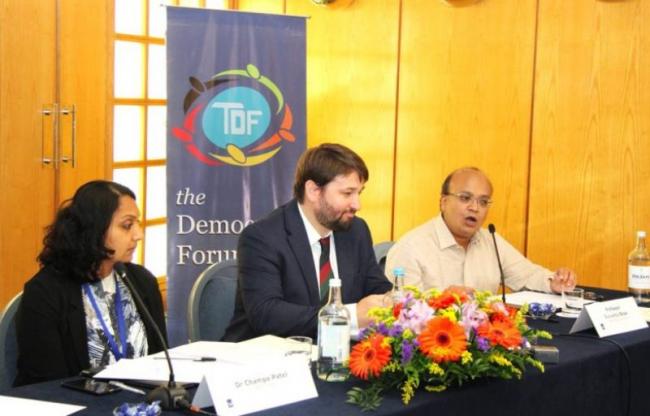
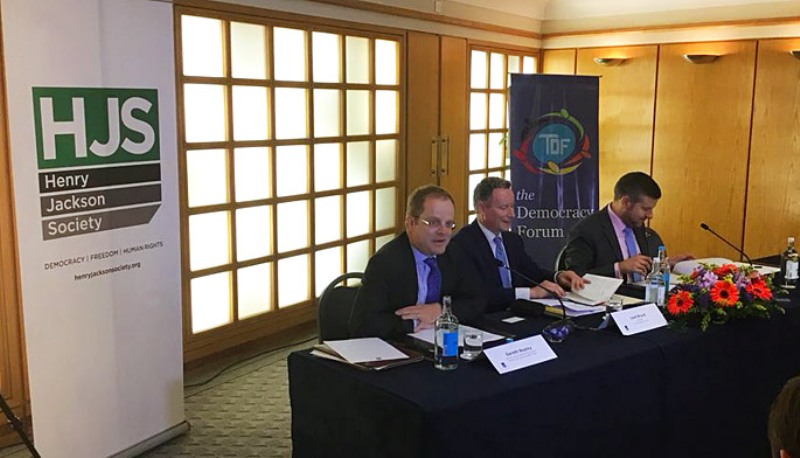
Britain must acknowledge the constraints imposed on India by its neighbours, in order to achieve a bolstered bilateral relation, said the President of the UK-based nonprofit The Democracy Forum during one of the group's recent seminars.
Lord Bruce, the president of the forum, also suggested that the United Kingdom must "also understand how India wants to be perceived as a global power, now it has come into its prime."
The seminar was a joint initiative undertaken by the Democracy Forum and the Henry Jackson Society.
According to Dr Alan Mendoza, Director of the Henry Jackson Society, India's Prime Minister Narendra Modi's no nonsense approach while dealing with diplomatic constraints has helped India become a force to reckon with in both the Asian and global platforms.
While areas like defence and security need to be looked after, highlighting those as possible stumbling blocks to the Indo-British relationship, Mendoza saw opportunities in diplomacy, trade and terrorism co-operation.
Speaking about India and Britain's security and defence relations, Aaditya Nikhil Dave of British think tank Royal United Services Institute (RUSI) said that even though it sustains a lot of misperceptions and missteps, including a mismatch in the two nation's security alignments vis-à-vis terrorism, especially cross-border terrorism emanating from Pakistan, the "foundations were essentially strong, and longstanding agreements continue to emerge all the time."
Contrary to many pundits, Duncan Bartlett, Editor of Asian Affairs magazine, hailed the India government's decision to try out demonitisation.
The November 2016 federal order did not go down well with many critics and was equally castigated by the Opposition in India.
However, Bartlett said it was a 'qualified success’ that had helped the Asian giant to combat corruption and raise more tax revenue.
The editor said that while people can still debate India's income inequality, one cannot ignore the large scale impact the move had, resulting in 'improved e-commerce, safer trains and more reliable insurance'. The fact that India is the fast growing economy in the world presently, bears testimony to the fact.
Experts urge to solve visa issues
Many felt that one possible irritant between India and Britain's relationship is the latter's parsimonious stance when it came to issuing visas for Indians.
Dr Champa Patel of Chatham House stated that while the relationship holds a huge potential, Britain needs to look into 'issues such as visa allocations and anti-terrorism legislation being used to deport highly skilled Indian workers'. She said that if not addressed quickly enough, the special bond brewing between the two nations may have a premature ending.
Echoing Patel's sentiment, Professor Sumantra Bose of the London School of Economics, said the UK needs to address the key irritants affecting UK India relations.
Pointing out three, greater restrictions on student visas, the high cost of multiple-entry visas and the presence of Indian fugitives in the UK, he said Britain must eliminate them and find the sweet spot of convergence.
Images: thedemocracyforumltd.com
Support Our Journalism
We cannot do without you.. your contribution supports unbiased journalism
IBNS is not driven by any ism- not wokeism, not racism, not skewed secularism, not hyper right-wing or left liberal ideals, nor by any hardline religious beliefs or hyper nationalism. We want to serve you good old objective news, as they are. We do not judge or preach. We let people decide for themselves. We only try to present factual and well-sourced news.
Support objective journalism for a small contribution.