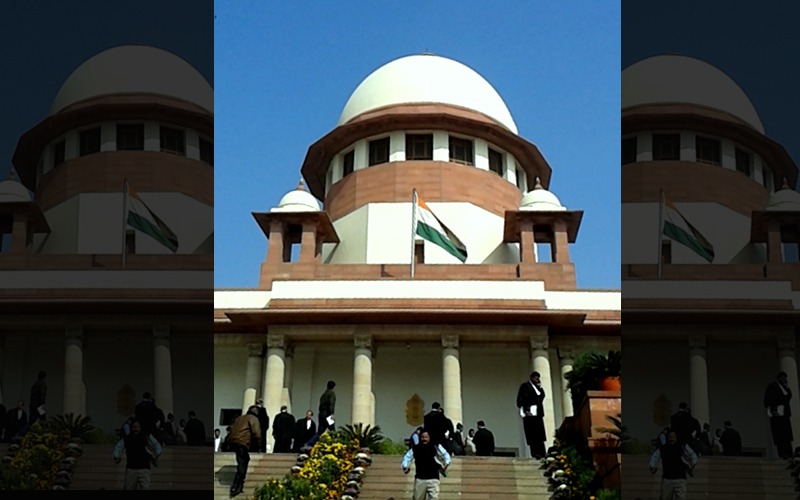
 Supreme Court
Dying declarations can't always be basis for conviction: Supreme Court
New Delhi/IBNS: The Supreme Court Wednesday said that dying declarations of a murder victim cannot be the sole basis for conviction of the accused "in cases where suspicion... is raised as regards the correctness (of the statement)".
The apex court observed this while hearing the plea of a Uttar Pradesh man held guilty of the murder of three people in 2014 and sentenced to death.
Calling for "great caution" when relying on dying declarations, the court said that "a dying declaration ..., while carrying a presumption of being true, must be wholly reliable and inspire confidence" and if there is "any suspicion over (its) veracity... or evidence on record shows the dying declaration is not true", then "it will only be considered as a piece of evidence but cannot be the basis for conviction alone."
Dying declarations can also only be accepted if it was made while the murder victim was in a "fit mental state", which may not have been the case in the matter heard by the court.
The Supreme Court's observations came as a bench of Justices BR Gavai, JB Pardiwala, and Prashant Kumar Mishra heard a plea by Irfan, who has been in jail for the past eight years after having been found guilty for the murder of his son Islamuddin and two brothers Irshad and Naushad.
The lower court relied on the dying declarations to convict Irfan.
The sentence was upheld by the Allahabad High Cour in 2018, after finding no discrepancies.
The Supreme Court, however, said it was not satisfied that the prosecution had proven its case beyond reasonable doubt and ordered Irfan's release immediately. The court accepted senior Advocate Gopal Sankaranarayanan's argument that the declarations were made while the men were suffering from 80 percent burns, calling into question their 'mental condition'.
Support Our Journalism
We cannot do without you.. your contribution supports unbiased journalism
IBNS is not driven by any ism- not wokeism, not racism, not skewed secularism, not hyper right-wing or left liberal ideals, nor by any hardline religious beliefs or hyper nationalism. We want to serve you good old objective news, as they are. We do not judge or preach. We let people decide for themselves. We only try to present factual and well-sourced news.
Support objective journalism for a small contribution.