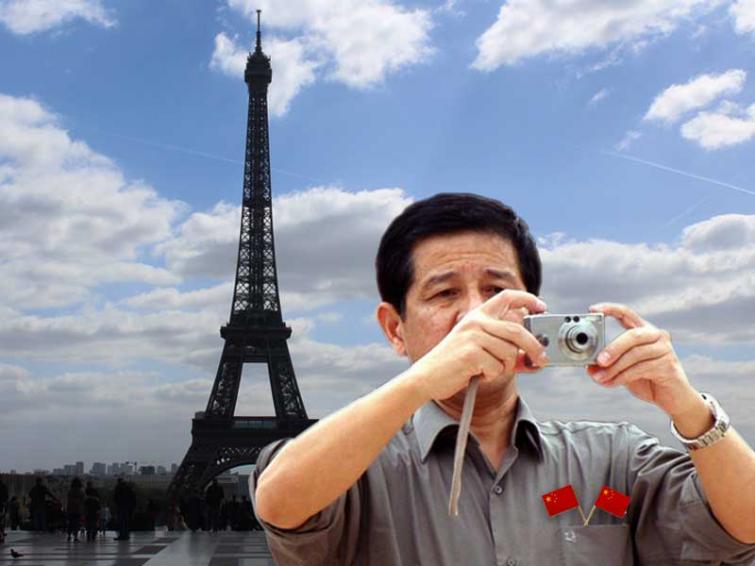
Does unmannerly Chinese tourist flow really boost tourism in countries vying for the pie?
Are Chinese tourists a boon for local economies of countries they visit or a curse going by the attendant annoyance they bring?
While tourism stakeholders around the world are vying for a pie of the Chinese tourist owing to their sheer number, their poor behaviour overseas has caught the world’s attention.
There are also questions raised on how much Chinese tourists really contribute to the economy of the country they are visiting.
Even though the Chinese tourists contribute the largest share of tourists to the Asia Pacific and to the global tourism industry than any other nation, claims of rude, uncivil and unhygienic behaviour by Chinese tourists are not unfounded.
From wrecking coral to throwing rubbish into the sea, to vandalizing heritage and defecating in public, travelers from China have a lot to learn about etiquette in the countries they visit, says an article in Travel Wire Asia.
Chinese tourists have made headlines internationally for incidents of misbehaviour, even prompting authorities in China to keep records of citizens doing anything illegal or inappropriate while in other countries.
With countries like Sweden, it even led to a diplomatic face-off last year after a Chinese family was evicted from a hotel in Stockholm for what the hotel said over disagreement over arriving hours before the check-in time and not refusing to leave.
After the Chinese tourists were removed from the hotel by Swedish police, the Chinese government reacted angrily and demanded action against the hotel from Swedish authorities.
.jpg)
Image: A dramatic scene (screenshot) of the Chinese tourist family removed from a hotel in Stockholm by Swedish Police
Things only worsened when weeks later a Swedish television programme aired a satirical video listing dos and don’ts for Chinese tourists, prompting China to call it racist and even going ahead to call an apology of Sweden over the same as "insincere" attempt.
According to BBC, when the incident was later posted on Chinese social media, there were millions of views and mixed comments with some slamming the Swedish police for treating them harshly while many point out the family was unnecessarily "dramatic" as shown on the social media footage of the family.
In response, the Chinese government has made efforts to improve the image of the Chinese people projected by its millions of tourists in overseas destinations—most famously by introducing a blacklist for tourists who have proven to have behaved exceptionally poorly.
Even the government and the CTNA (Chinese Tourism National Association) want Chinese tourists to correct their behaviour. Things reached a state where Japan wants to create specific zones only dedicated to Chinese tourists
Wang Yang, one of China's four deputy prime ministers, told ‘The Guardian’ that while other countries had welcomed Chinese tourists, the quality of some travellers was not high.
He said: "They speak loudly in public, carve characters on tourist attractions, cross the road when the traffic lights are still red, spit anywhere and [carry out] some other uncivilised behaviour. It damages the image of the Chinese people and has a very bad impact."
Switzerland, for example, considers them loud and rude, going as far as introducing separate trains for Chinese tourists. The notice, published in a local newspaper, also includes an illustration instructing tourists to sit on toilet seats rather than to squat on them, media reports said.
According to Travel Wire Asia, in 2013, a 15-year-old defaced a 3,5000-year-old Egyptian artifact at a temple in Egypt, writing, “Ding Jinhao was here”.
"A year later, a Thai AirAsia flight bound for Nanjing, China was forced to return to Bangkok after an unruly Chinese passenger threw scalding hot water on a flight attendant.
"In 2016, Chinese tourists, armed with selfie sticks, appeared on Japanese TV clambering over Japan’s national symbol, the ‘sakura’ (cherry blossom) tree, in an attempt to 'get the best shot',” the article says.
In another incident, a kangaroo was killed in captive and another injured at Fuzhou Zoo in Fujian Province when Chinese zoo-goers attempted to “make it jump”. The visitors had thrown rocks at the animals that were in a fenced enclosure, said media reports.
Thailand’s Tourism Authority of Thailand (TAT) has sought help from its Chinese counterpart to warn Chinese tourists to behave while visiting Thailand.
The Hokkaido government in Japan has issued a booklet on bad manners aimed at Chinese visitors.
Outbound Chinese tourism has grown its global footprint in the recent years and so countries and destinations around the world are eager to attract them, till some hard truths come out.
According to a Bloomberg article, overwhelmingly, they come from a smartphone-addicted generation that is rewriting the rules. "The ubiquitous flag-following Chinese tour groups are giving way to what the industry calls FITs - free, independent travellers - who are using the internet to plan itineraries, book flights, translate signs and chronicle their exploits," the article says.
However more isn’t always better. Poorly designed and/or implemented policies can result in a tourism influx that produces negative dividend, even as the number of Chinese visitors skyrockets.
The chief reason for this lack of revenue depends on how much Chinese tourists are spending and where they are spending it.
Chinese tourists have a reputation to be small spenders and much to the frustration of tour operators, that local firms receive little revenue.
Chinese tourists book tours through a Chinese tourist agency and pay through Chinese banks. They use Chinese payment apps like Alipay and WeChat, according to the media reports.
These tourists either bring food with them from home or often eat at Chinese-owned restaurants because of agreements between the tour operators and owners, and the operators buy rooms in bulk at lower prices, according to media reports.
In short, for the most part, foreign businesses aren’t cut out of this peculiar revenue stream.
Moreover, the majority of revenue circulation is never even converted into the local currencies of the destination countries, thanks in part to E-payment platforms like WeChat Pay and Ali Pay which bypasses the taxing system of the country they visit.
Nepal is one country which in fact banned payment apps WeChat Pay and AliPay saying it does not help them in earning revenue and results in a loss of income.
The Nepal Rastra Bank said: "Any digital transaction made with unregistered foreign payment system like WeChat Pay and AliPay is illegal," Niroula told Reuters. "Anyone using such platforms can be punished."
Thailand has been one of the most prominent examples of suffering from Chinese tourists and the country has gone to great lengths in combating so-called “zero-dollar tours,” that contribute little or nothing to the Thai economy, but put strain on transportation infrastructure and lead to crowded streets, according to Jing Travel.
Vietnam too has attempted to address the cutting out of Vietnamese operators and businesses from Chinese tours, it said.
According to South China Morning Post, in Hong Kong, tensions have risen against Chinese tourists and spilled into furious name-calling in 2014.
It said anger reached boiling point earlier that year when a mainland couple allowed their two-year-old to defecate on a Hong Kong street. Mocking the mainlanders, a group of Hong Kong protesters sat on yellow plastic poos in a crowded mall.
According to these media reports, Chinese President Xi Jinping at one point urged his countrymen to behave overseas. "Do not leave water bottles everywhere. Do not damage coral reefs. Eat less instant noodles and more local seafood," Xi advised during an official visit to the Maldives in 2014.
In the Indian Ocean island nation, whose economy relies heavily on tourism and receives substantial Chinese, some luxury resorts had earlier stopped providing Chinese guests with hot water to stop those skipping meals in favour of cup noodles, triggering anger and calls for a boycott on China's social media.
While in many countries now, just because of sheer number China is a focus country to woo tourists, the baggage they come with far offsets the benefits of quantity.
As a woman offering her house for homestay in Scotland's Isle of Skye tells an Indian tourist: "Indians are far, far ahead in terms of civilized behaviour and depth. China despite all its state-regulated economic development has a long, long way to catch up with an Indian abroad."
(Compiled by Suryodoy Mandal)
Support Our Journalism
We cannot do without you.. your contribution supports unbiased journalism
IBNS is not driven by any ism- not wokeism, not racism, not skewed secularism, not hyper right-wing or left liberal ideals, nor by any hardline religious beliefs or hyper nationalism. We want to serve you good old objective news, as they are. We do not judge or preach. We let people decide for themselves. We only try to present factual and well-sourced news.
Support objective journalism for a small contribution.