 Bengal
Bengal liquor scam: Confidential excise report names Abhishek Banerjee in alleged revenue diversion scheme
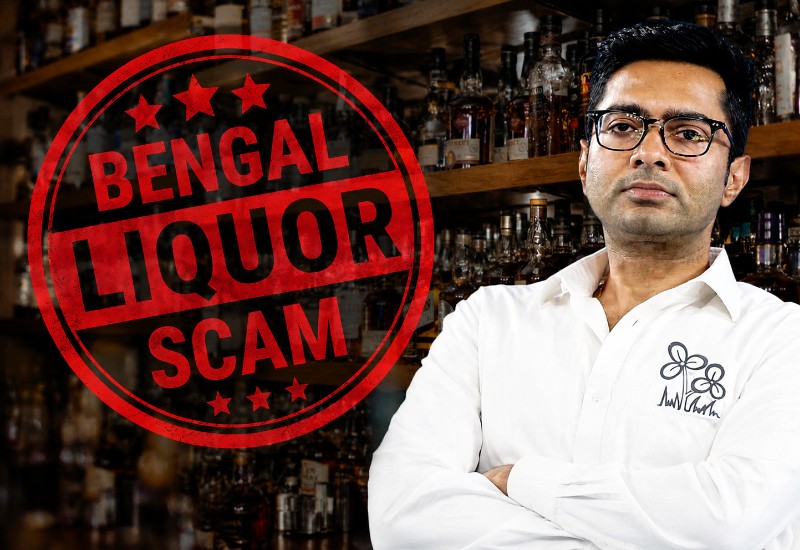
A confidential report prepared by the West Bengal Excise Department has alleged that sweeping changes introduced to the state's liquor distribution system in 2017 created a monopolistic structure that diverted thousands of crores of rupees and financially benefited senior Trinamool Congress (TMC) leaders, including party National General Secretary Abhishek Banerjee.
According to the report, reviewed by The Statesman, the policy overhaul replaced a competitive network of private liquor wholesalers with a state-controlled distribution model through the West Bengal State Beverages Corporation Limited (WBSBCL).
The report alleges that the changes were implemented under the stated objectives of ensuring transparency, preventing cartelisation, improving consumer choice and expanding liquor availability across the state.
The report has reportedly been submitted to West Bengal Chief Secretary Manoj Kumar Agarwal.
It also claims that Chief Minister Suvendu Adhikari has been briefed on its findings.
BJP targets TMC
Reacting to the allegations, BJP leader Amit Malviya accused the Trinamool Congress of operating a politically protected corruption network.
"The details emerging from the West Bengal liquor scam point to a deeply entrenched culture of corruption under the Trinamool Congress. The allegations suggest a syndicate that operated with political patronage, with Abhishek Banerjee at its centre and all of it unfolding under Mamata Banerjee's watch," Malviya said.
Referring to complaints made by IFB Agro Industries Ltd, he added: "The IFB complaint was not a private grievance; it was a matter reported to the stock exchange and placed in the public domain. The truth can no longer be buried."
"Those who looted the people of West Bengal and extorted businesses must be held accountable. The law will take its course, and every person involved, regardless of position or influence, will have to answer for their actions."
In a separate post on X, Malviya alleged that money collected from liquor bottlers ultimately benefited the Trinamool Congress and Abhishek Banerjee.
How the liquor distribution system changed
The report traces the controversy back to 2017, when West Bengal State Beverages Corporation (WBSBCL) was established to replace private wholesalers, known as "Trades", that previously held distribution licences under the Bengal Excise Act, 1909.
Before the change, 55 licensed wholesalers operated independently, allowing manufacturers to choose distributors based on commercial considerations.
Retailers also had access to multiple supply channels.
The report describes the earlier system as one based on "fair trade practices, healthy competition and timely supply of liquor at the ultimate consumption points".
The WBSBCL model centralised the distribution network.
According to the report, this shift introduced a new layer of distributors and effectively replaced a decentralised system with what it describes as a "Monopolistic Business Model".
The report alleges that the new arrangement functioned under the supervision of former Excise Commissioner Uma Shankar S and was supported by a group of senior excise officials.
It further claims that the system operated at the behest of Abhishek Banerjee.
Report Alleges Revenue Diversion Through Distributor Network
One of the report's most serious allegations is that the distributor model was deliberately designed to divert funds from the state exchequer.
According to the document, distributors collected additional charges from bottlers and liquor manufacturers, including Rs 4 per crate for warehouse rentals and Rs 3 per crate for transportation.
The report claims these payments were mandatory and significantly increased operational costs for manufacturers.
It further alleges that a portion of distributor profits that should have accrued to the government was instead redirected elsewhere.
The report states that the "whole policy of introduction of such Distributors was designed to siphon out money for the AITC in the name of garnering revenue for the Government Exchequer."
The document also alleges that funds ultimately reached a property at 9 Camac Street, also known as Shantiniketan, which is associated with Abhishek Banerjee.
IFB Agro Industries raised concerns
The report cites objections raised by IFB Agro Industries Ltd, one of the companies that allegedly resisted the distribution arrangement.
In a letter dated May 18 to the Excise Commissioner, the company sought an immediate end to what it described as extortion and embezzlement linked to the liquor distribution framework.
The letter, which was also marked to the Chief Secretary, referred to several previous communications sent to the department in 2025 regarding what the company described as "illegal interference by certain Excise Officials arising out of our refusal to comply with their unlawful demands."
"We are sure that, you must have conducted the required investigation on the issues raised. We would request you to kindly share the facts found and the action taken against the officers, indulge in such activities," the company wrote.
The letter further stated: "Additionally, we would like to bring to your kind notice that, in light of the issues raised in our earlier communications and as already communicated, the arrangement has been made solely based on your instructions, and whereunder we have been compelled to make steps to inform the new Government of the activities undertaken by you in this regard."
According to sources quoted by The Statesman, bottlers who opposed the arrangement allegedly faced pressure to comply.
The report also claims that charges were collected on country liquor at the rate of Rs 3 per bottle.
IFB Agro Industries did not respond to requests for comment before publication, according to the newspaper.
Officials behind the policy framework
The report identifies five officials who were involved in drafting the policy document that led to the creation of WBSBCL.
These include former Special Commissioner (Revenue) and WBSBCL General Manager (Operations) Goutam Ghosh; Senior Joint Commissioner of Revenue Shantanu Acharya; Deputy Commissioner of Revenue Sanchayan Ganguly; Additional Commissioner of Revenue Rajarshi Chakraborty; and Special Commissioner (HR) Kunal Biswas.
According to the report, the committee recommended the establishment of WBSBCL and approved structural changes to the state's liquor distribution mechanism.
The report also criticises the introduction of a two-tier excise duty collection system.
Under the revised model, a portion of the duty was collected at manufacturing units while additional excise duty was collected at the distributor level.
It states that the change resulted in delayed revenue realisation and periodic disruptions in the WBSBCL distribution network when distributors failed to maintain adequate balances in their accounts.
Officials respond
Abhishek Banerjee could not be reached for comment despite repeated attempts by The Statesman, the report said.
West Bengal Excise Commissioner Kaushik Bhattacharya declined to comment.
"I will not comment on this issue at all. There are standing instructions that only authorised spokespersons can speak to the media. I am not an authorised spokesperson," he told the newspaper.
Former Excise Commissioner Uma Shankar S also declined to discuss the allegations.
"It was the government's policy. It was not my policy. I should not speak on it. In fact, I am not authorised to speak to the media," he said.
One signatory to the 21-page policy document, speaking anonymously, said the committee had been formed following instructions from the Finance Department.
"As far as I can recall, the Finance Department had directed that a committee be formed. I was possibly a member of that committee. The committee examined the matter and submitted its recommendations to the State Government. The final decision, however, rested with the Government," the official told The Statesman.
Several other officials named in the report did not respond to calls or messages seeking comment.
Bottlers consider further action
According to The Statesman, liquor bottlers are now considering collective action and may seek compensation for losses allegedly incurred under the distribution system.
A senior industry source told the daily: "We shall be demanding our money, the money that was illegally extorted from us by the nexus of Abhishek Banerjee and corrupt excise officials, back. We should be compensated for our losses."
The source added that industry representatives are planning to raise the issue with the state government in the coming days.
Support Our Journalism
We cannot do without you.. your contribution supports unbiased journalism
IBNS is not driven by any ism- not wokeism, not racism, not skewed secularism, not hyper right-wing or left liberal ideals, nor by any hardline religious beliefs or hyper nationalism. We want to serve you good old objective news, as they are. We do not judge or preach. We let people decide for themselves. We only try to present factual and well-sourced news.
Support objective journalism for a small contribution.