 RHA
RHA
After CJP and E20 Janta Party, ‘Reservation Hatao Andolan’ goes viral with 5.9M Instagram followers
India’s latest youth-led online debate is moving beyond examination reforms and paper leaks, with a rapidly growing social media campaign now putting the country’s reservation system at the centre of discussion.
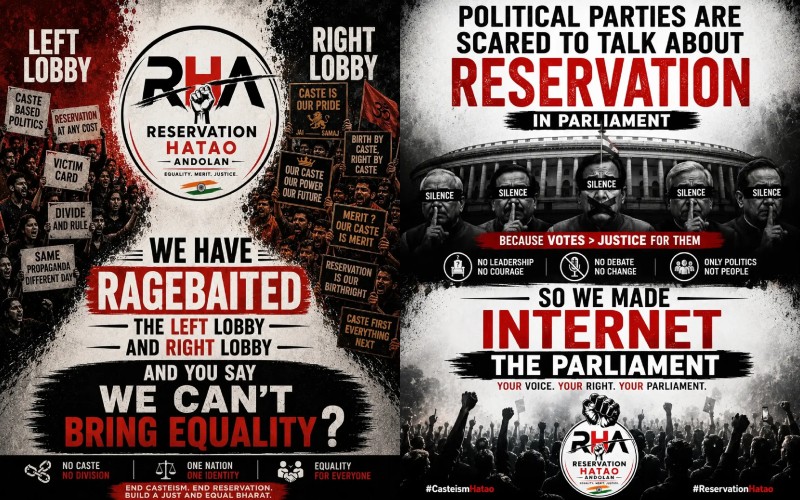
The Instagram account ‘Reservation Hatao Andolan’ (RHA) has crossed 5.9 million followers, according to recent reports, turning what describes itself as a citizen-backed, non-political campaign into a significant online presence.
The account has more than 100 posts and says it has no political affiliation. Its founder or founders have not been publicly identified.
The campaign has emerged shortly after the rise of the Cockroach Janta Party (CJP), a satirical youth-led movement that began around concerns over competitive examinations and eventually became a nationwide protest demanding accountability and the resignation of Union Education Minister Dharmendra Pradhan.
Pradhan submitted his resignation on July 25 after weeks of protests.
CJP founder Abhijeet Dipke subsequently announced the withdrawal of the agitation, describing the development as a victory for the movement.
The new campaign, however, has shifted the conversation towards a far more politically and socially sensitive question: whether caste-based reservation should continue in its present form.
From paper leak anger to reservation debate
The CJP movement initially drew attention around alleged irregularities in competitive examinations, including concerns involving the NEET-UG examination.
Students and young people who joined the campaign raised wider questions about paper leaks, recruitment delays, examination irregularities and vacancies.
The movement eventually expanded beyond its original online presence into street protests, including a prolonged sit-in at Delhi’s Jantar Mantar.
On July 25, after Pradhan’s resignation, CJP announced that its agitation would be withdrawn after claiming that the Centre had accepted its principal demands.
The Reservation Hatao Andolan has emerged in a different context.
Rather than focusing primarily on examination administration, it has placed reservation itself at the centre of its campaign.
Its rapid growth on Instagram has brought students, academics and working professionals into a fresh online discussion about merit, caste identity, access to education and the distribution of opportunities.
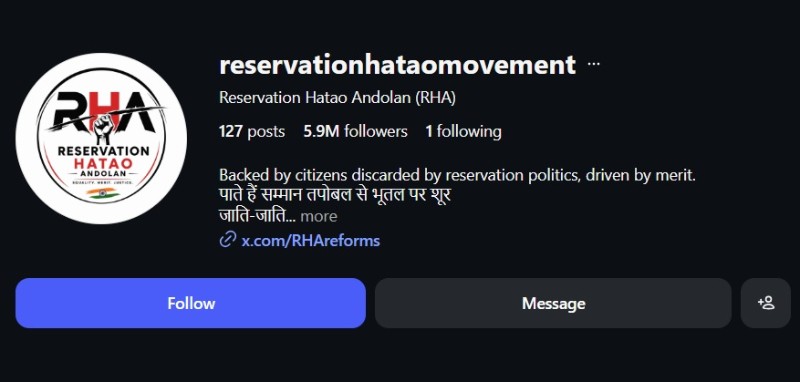 Reservation Hatao Andolan's Instagram profile
What does 'Reservation Hatao Andolan' say?
The campaign describes itself as a citizen-backed movement and says it is not affiliated with a political party.
Its Instagram profile carries the phrase associated with B R Ambedkar, “Educate-Agitate-Organize”, alongside the Hindi message, “सारी जाति एक समान, मेरा बस ये देश महान” — broadly meaning that all castes are equal and expressing a wish for the nation’s well-being.
One of its posts argues that reservation undermines merit, deepens caste divisions and affects the quality of education by reducing competition.
The campaign advocates equal opportunities based on merit rather than caste.
It has also proposed what it describes as a roadmap for reform.
It argues that if the ultimate objective is to eliminate caste-based discrimination, the government should eventually stop requiring or recognising caste identity in everyday public life.
The campaign has nevertheless received a divided response.
While supporters have rallied around its call for a reservation-free system, critics have questioned whether removing affirmative action without first addressing entrenched social and educational inequalities would produce genuine equality.
Why some students are supporting the campaign
Among those supporting the campaign are students who say the present system can create frustration among candidates competing for limited seats in higher education and employment.
Harsh Kumar, a B.Sc. (Hons.) student, said he supports what he described as “one-time reservation”.
Recalling his experience of a postgraduate entrance examination, Kumar said students from different categories often prepare according to their respective qualifying cut-offs.
He described how one of his friends from the Scheduled Caste category prepared around the relevant cut-off, while another friend from the Scheduled Tribe category worked hard and secured admission to one of the top three colleges.
Kumar said his own score was close to that of his ST-category friend, but category-specific cut-offs meant that he could not secure the college he had expected based on his marks.
Such experiences have become part of the wider online argument over how India should balance merit, representation and social disadvantage.
Students seek changes, but views remain divided
Abhas, a mass communication student, argued that the government should consider policies that provide greater support to meritorious students from the general category.
He suggested that where seats reserved for SC and ST candidates remain vacant because eligible candidates are unavailable or do not meet the required criteria, those seats could instead be offered to meritorious general-category candidates rather than remaining vacant.
At the same time, he acknowledged that reservation alone does not explain the distribution of social and economic power in India.
According to him, many members of historically privileged communities continue to occupy influential positions, indicating that wider questions of inequality and access also need attention.
Another student, Ankit Kumar, said social conditions have changed and young people today have greater access to educational opportunities than previous generations, but argued that weaknesses in the education system and the continuing influence of caste can still make competition more difficult.
'Education inequality is central to the debate'
Experts opined that education inequality is central to the ongoing debate over reservation.
Dr Sant Prakash Singh, an Assistant Professor at Delhi University, said the current anger among young people should be viewed against a wider backdrop of problems in the education and recruitment system.
He pointed to repeated paper leaks, recruitment delays, irregular examinations and unfilled vacancies as sources of long-term frustration among students and job seekers.
According to Singh, addressing these structural problems could change the way younger generations view reservation.
He also stressed that reservation was introduced in response to historical social, cultural and educational inequalities, and students need to understand history before reaching conclusions about the policy.
A broader understanding of reservation’s origins and subsequent development, Singh argued, would help young people better understand the evolution of India's education and affirmative-action framework.
Singh does not support the complete removal of reservation at present. Instead, he called for a wider discussion involving policymakers, educationists, sociologists and constitutional experts.
He also stressed the importance of improving access to quality education, strengthening government-school infrastructure, ensuring trained teachers, increasing employment opportunities and improving the overall education budget.
He argued that caste studies and social-justice education also have a role in helping students understand why affirmative action was introduced.
The professor further suggested that examination systems should provide multiple opportunities to candidates, vacant seats should be filled promptly and recruitment processes should become more predictable.
What is the constitutional basis of Reservation?
Reservation in India is rooted in the constitutional framework that permits special provisions for socially and educationally disadvantaged groups.
Articles 15(4) and 16(4) provide the constitutional basis for affirmative measures in education and public employment, while Article 46 directs the State to promote the educational and economic interests of weaker sections.
The current Constitution is maintained by the Legislative Department of the Ministry of Law and Justice.
The system has evolved considerably since Independence.
Following the implementation of the Mandal Commission recommendations, 27 percent reservation was provided for Other Backward Classes (OBCs) in central government employment.
The Supreme Court's landmark Indra Sawhney judgment upheld OBC reservation while establishing the exclusion of the socially and educationally advanced sections — commonly referred to as the creamy layer — from those benefits.
In 2019, the Constitution was amended to introduce a 10 percent reservation for Economically Weaker Sections (EWS).
At the central level, the commonly cited reservation percentages are 15 percent for Scheduled Castes, 7.5 percent for Scheduled Tribes, 27 percent for OBCs and 10 percent for EWS, amounting to 59.5 percent.
A 2019 government notification confirms the 15 percent, 7.5 percent, 27 percent and 10 percent allocations in the specified central educational context.
The Supreme Court has repeatedly considered the relationship between reservation, equality and disadvantage.
Its judgments have also emphasised that affirmative action operates within a broader constitutional framework aimed at addressing substantive inequality rather than simply treating every individual identically.
Debate over who benefits
The fast-growing online campaign has also revived another question: whether reservation benefits are reaching the most disadvantaged members of eligible communities.
Experts cited in the debate argue that awareness remains uneven.
Some people who qualify for affirmative-action benefits may not know about the available opportunities, eligibility conditions or application procedures.
Improving awareness and access, they say, is an important part of ensuring that reservation reaches people who need it.
At the same time, resentment among some unreserved-category candidates has become increasingly visible online, particularly when candidates compare qualifying marks or competition for limited seats.
Singh said these concerns should not simply be dismissed, but neither should they become a source of deeper social division.
The debate, he argued, requires engagement with constitutional experts, educationists, sociologists and policymakers so that questions surrounding merit, representation and social justice can be discussed based on evidence and constitutional principles.
E20 Janta Party adds another layer to online protest culture
The Reservation Hatao Andolan is not the only issue-based social media campaign to attract attention following the CJP's rise.
The E20 Janta Party, another satirical online page whose founder's identity remains unclear, has also attracted attention.
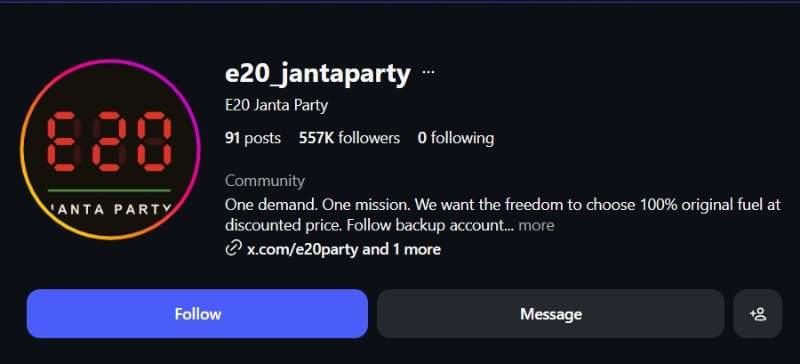 E20 Janta Party's Instagram profile
The campaign appears to focus on the Centre's push for E20 fuel, a petrol blend containing 20 percent ethanol.
The government's ethanol-blending programme is intended to reduce dependence on imported crude oil, lower emissions and create additional demand for ethanol produced from agricultural commodities.
The policy has also generated debate over vehicle compatibility, fuel efficiency and the implications of increased ethanol production for agriculture and water use.
Together, these campaigns illustrate how issue-specific online pages can quickly attract large audiences and turn policy questions into youth-driven digital debates.
New digital battleground for policy debates
The rise of Reservation Hatao Andolan comes at a moment when social media is increasingly becoming a space where young Indians discuss education, employment, government policy and social justice.
The campaign's rapid growth has placed reservation — one of India's most politically and constitutionally consequential policies — at the heart of a new online conversation.
Support Our Journalism
We cannot do without you.. your contribution supports unbiased journalism
IBNS is not driven by any ism- not wokeism, not racism, not skewed secularism, not hyper right-wing or left liberal ideals, nor by any hardline religious beliefs or hyper nationalism. We want to serve you good old objective news, as they are. We do not judge or preach. We let people decide for themselves. We only try to present factual and well-sourced news.