2020 Bengal Budget paves way for reforms in social sector: Amit Mitra
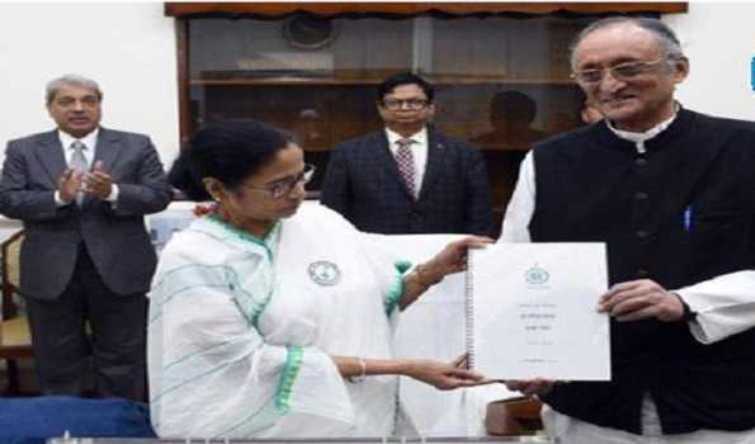
Kolkata/UNI: The 2020 Bengal Budget has opened the way for further reforms in the social sector through the introduction of five new schemes, said State Finance Minister Amit Mitra during presentation of budget for FY 2030-21.
The five schemes are Bandhu, Jai Johar, Bina Mulya Samajik Suraksha, Chaa Sundari and Hasir Alo.
Bandhu Scheme is a pension scheme, under which people over sixty years of age belonging to the scheduled caste (SC) communities and not covered under any other pension scheme, would get a pension of Rs 1,000 per month.
He said Rs 2,500 crore has been allocated for the financial year (FY) 2020-21, which is expected to benefit about 21 lakh people.
Jai Johar Scheme is a pension scheme, under which people over sixty years of age belonging to the Adivasi and other Scheduled Tribe (ST) communities, not covered under any other pension scheme, would get a monthly pension of Rs 1,000.
Rs 500 crore has been allocated for the FY 2020-21, which is expected to benefit about four lakh people," Mitra announced.
Bina Mulya Samajik Suraksha Scheme: The unorganised workers in the construction, transport and other sectors of Bangla are given various free-of-cost beneï¬ts, like compensation for accidental death or disability, health facilities, a grant for education of children and others, under the Samajik Suraksha Yojana (SSY).
They are also provided with the benefits of a provident fund, encashable on reaching the age of 60 or on death or discontinuation from the scheme, for which the beneficiary deposits Rs 25 per month and the State Government, Rs 30.
"Now the State Government has introduced Bina Mulya Samajik Suraksha (BMSS), under which the State Government, besides providing other beneï¬ts free of cost, will also provide the entire funding for the provident fund; hence, now the provident fund also becomes free for the beneficiary. This is expected to benefit about 1.50 crore families. Rs 500 crore has been allocated for BMSS for FY 2020-21," said the State Finance Minister.
Chaa Sundari: For the approximately three lakh permanent workers on rolls in the 370 tea gardens in the State, there is something to cheer too. Among them, almost 50 per cent are women and a majority belong to scheduled tribe communities.
"The State Government is already giving rice at Rs 2 per kg, free electricity, health beneï¬ts, mid-day meals for their school-going children and many other beneï¬ts," he said,
"Many of these workers though do not have a house to call their own due to their poor economic condition. With this in mind, the State Government has introduced a scheme named ‘Chaa Sundari’. Under which, within the next three years, the government will provide funds for the construction of houses for all the permanent tea garden workers who do not have a house of their own. Rs 500 crore has been allocated for the scheme for FY 2020-21," said he.
"Hasir Alo: Over the last eight years, the State has achieved 99.90 per cent electriï¬cation. Besides this, the State Government is providing electricity at low cost to the poor consumers. But the poorest of the poor still find it difficult to pay their electricity bills," Mitra said.
With the introduction of the Hasir Alo Scheme, this problem would be solved, he added.
The consumers who are extremely poor, categorised as that for whom quarterly consumption (three-monthly) of electricity do not cross 75 units, also called lifeline consumers, will no longer be charged for electricity from April 1, 2020.
This will beneï¬t around 35 lakh families. For this scheme, Rs 200 crore has been allocated for FY 2020-21, he stated.
Image credit : UNI
Support Our Journalism
We cannot do without you.. your contribution supports unbiased journalism
IBNS is not driven by any ism- not wokeism, not racism, not skewed secularism, not hyper right-wing or left liberal ideals, nor by any hardline religious beliefs or hyper nationalism. We want to serve you good old objective news, as they are. We do not judge or preach. We let people decide for themselves. We only try to present factual and well-sourced news.
Support objective journalism for a small contribution.