 IGNCA
IGNCA
Tribal concept ‘halma’ can show the way for self-reliance to society at large, says minister
New Delhi/IBNS: The expansion of the concept of ‘halma’ prevalent among the tribes of India can be one of the ways to resolve climate change and other issues faced by society at large, said Union Minister of State for Health and Family Welfare, Dr. Bharati Pravin Pawar.
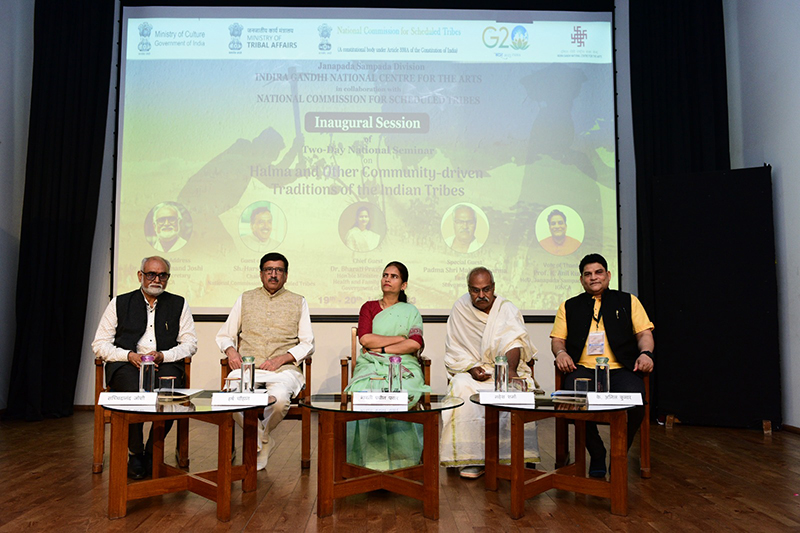
She was speaking at the inauguration of a two-day national seminar titled ‘Halma and Other Community- driven Traditions of the Indian Tribes’, organised by the Janapada Sampada Division of Indira Gandhi National Centre for the Arts (IGNCA) in collaboration with National Commission for Scheduled Tribes.
In simple terms, ‘halma’ is a tribal concept when the members seek help from within the group for resolving a problem.
Apart from Dr Pawar, who was the chief guest for the inaugural session, the seminar was also attended by Harsh Chouhan, Chairperson, National Commission for Scheduled Tribes, Padmashri Mahesh Sharma, Founder, Shivganga Jhabua, Dr. Sachchidanand Joshi, Member Secretary, IGNCA, among others.
Padmashri Mahesh Sharma is a social activist, working for sustainable development of tribal villages and revival of tribal traditions in Jhabua, Madhya Pradesh, for the past 25 years.
Dr. Pawar cited examples of how ‘halma’ has helped in development of roads and other infrastructure in the region where it is practiced.
“Traditions such as Halma and others like it teach us not to be dependent on others; rather make us self-reliant and self-dependent. We need to identify more such traditions and practices and bring them to the mainstream for holistic development of our society,” she said.
Harsh Chouhan too reiterated that in Indian society, a tradition like ‘halma’ is an example of community participation and sustainable development.
Dr. Sachchidanand Joshi said traditions like ‘halma’ are an education in social work.
Prof. K. Anil Kumar extended the formal vote of thanks at the inaugural session.
Later, scholars from across the country presented papers on different aspects of ‘halma’.
Support Our Journalism
We cannot do without you.. your contribution supports unbiased journalism
IBNS is not driven by any ism- not wokeism, not racism, not skewed secularism, not hyper right-wing or left liberal ideals, nor by any hardline religious beliefs or hyper nationalism. We want to serve you good old objective news, as they are. We do not judge or preach. We let people decide for themselves. We only try to present factual and well-sourced news.
Support objective journalism for a small contribution.