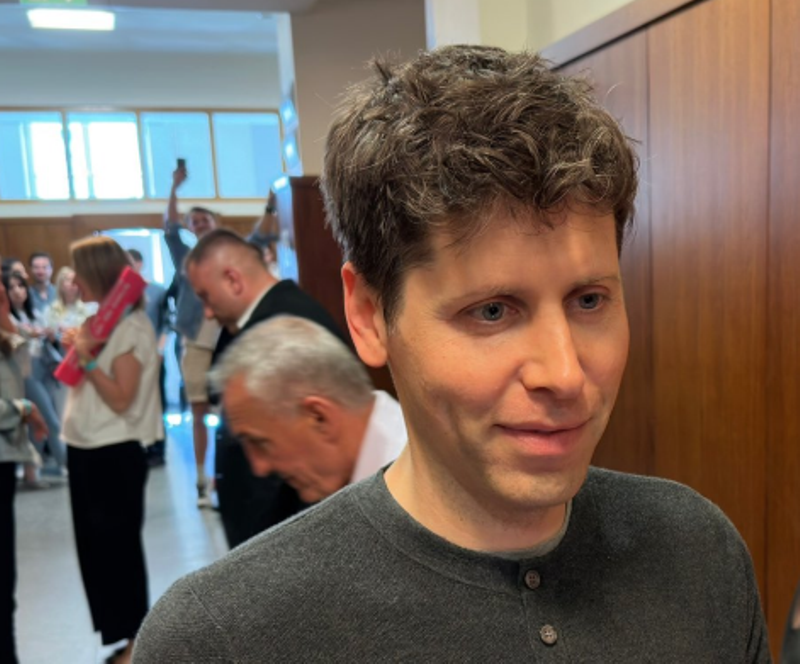
Sam Altman’s Merge Labs explores non-invasive brain-computer tech to read human mind
OpenAI CEO Sam Altman is reportedly planning to support a brain implant company, Merge Labs, in an attempt to rival Elon Musk's Neuralink, according to media reports.
The ChatGPT creator is reportedly enlisting the help of Alex Blania, CEO of Tools for Humanity (formerly known as Worldcoin), the company behind Altman’s iris-scanning digital ID initiative.
According to a report by The Verge, OpenAI CEO Sam Altman is now also bringing on board Mikhail Shapiro, an award-winning biomolecular engineer, to collaborate with Blania.
With Shapiro’s involvement, the brain implant venture appears to be taking a distinct route from Neuralink.
At Caltech, Shapiro has made major strides in developing non-invasive neural imaging and control technologies, using ultrasound to interact with the brain without requiring open-skull surgery.
Shapiro has also contributed to gene therapy research that enables cells to respond to and become visible through ultrasound—an approach that aligns with a Bloomberg report suggesting the direction Merge Labs may take for its first product.
In a recent video, Shapiro discussed the potential of harnessing sound waves and magnetic fields to build a brain-computer interface.
Instead of implanting electrodes in brain tissue, he said it’s “easier to introduce genes into cells” so that they can respond to ultrasound.
Back in August, Altman said he had no intention of implanting anything in his brain, warning that doing so “would kill [his] neurons.”
He added, “I would like to be able to think something and have ChatGPT respond to it. Maybe I want read-only. That seems like a reasonable thing.”
The Financial Times earlier reported that Merge Labs plans to raise around $250 million from OpenAI’s venture fund, with Altman serving as a co-founder but not taking part in the startup’s daily operations.
Support Our Journalism
We cannot do without you.. your contribution supports unbiased journalism
IBNS is not driven by any ism- not wokeism, not racism, not skewed secularism, not hyper right-wing or left liberal ideals, nor by any hardline religious beliefs or hyper nationalism. We want to serve you good old objective news, as they are. We do not judge or preach. We let people decide for themselves. We only try to present factual and well-sourced news.
Support objective journalism for a small contribution.