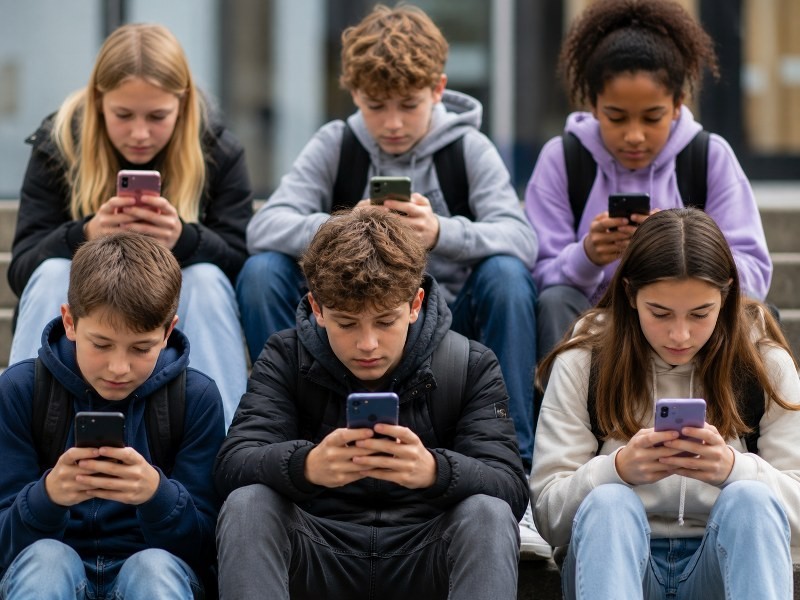
 NZ Social Media Ban
New Zealand's bold move against social media: Under-16s to face access ban
New Zealand is set to join the growing list of countries seeking to restrict social media access for children under 16, with Prime Minister Christopher Luxon announcing plans to introduce legislation aimed at protecting young users online.
In a statement on Monday, Luxon said his government will introduce the Online Safety (Minimum Age and Child Safety Risk Assessment) Bill, which will prevent children under 16 from using social media platforms and place greater responsibility on technology companies to protect children online.
“We simply cannot accept the harm being done to a generation of New Zealand children,” Luxon said.
He said one in three children aged between 13 and 17 in New Zealand now spends at least five hours a day on social media.
“Social media is exposing children to harmful content, addictive technology and pressures they are not equipped to deal with,” Luxon said, adding that excessive social media use is affecting children's family life, mental health, sleep and education.
“Obviously, parents have a role to play in monitoring what social media platforms their children are on, but so do social media companies,” he said.
“We have protections to keep children safe in the real world and we need them in the virtual world too,” Luxon added.
What does the proposed Bill say?
Under the proposed legislation, high-risk social media platforms such as Instagram, TikTok, Snapchat and Facebook will be required to take reasonable steps to verify that users are aged 16 or above.
Platforms could use several methods for age verification, including existing account information, facial age estimation, digital ID services and formal identification documents.
The Bill will also require platforms used by children to regularly assess the risks they pose to young users and report on how those risks are being identified and reduced.
Technology companies that fail to comply could face significant penalties of up to 10 per cent of their global revenue.
The proposed regulations will also cover emerging technologies, including AI companion platforms.
In addition, the government plans to establish an online safety regulator within the Department of Internal Affairs. The regulator will independently monitor compliance, investigate platforms and enforce the proposed law.
Education Minister Erica Stanford said the Bill would bring New Zealand in line with countries that are increasingly placing greater responsibility on technology companies to protect children online.
“The Bill places legal obligations on platforms. No penalties are proposed for children, their parents or caregivers,” Stanford said.
The Online Safety (Minimum Age and Child Safety Risk Assessment) Bill is scheduled to be introduced in Parliament on Monday.
New Zealand's move follows neighbouring Australia, which introduced a landmark ban on social media use by children under 16 in late 2025.
Following Australia's move, several other countries have either introduced legislation or are considering similar restrictions on social media access for under-16s. These include Indonesia, Vietnam and Brazil.
Support Our Journalism
We cannot do without you.. your contribution supports unbiased journalism
IBNS is not driven by any ism- not wokeism, not racism, not skewed secularism, not hyper right-wing or left liberal ideals, nor by any hardline religious beliefs or hyper nationalism. We want to serve you good old objective news, as they are. We do not judge or preach. We let people decide for themselves. We only try to present factual and well-sourced news.
Support objective journalism for a small contribution.