 Women
Women
Mumtaz M Kazi: The Woman Behind Asia's First Diesel Engine Train
“With Grace And Determination, No Barrier Is Too Great And No Dream Is Too Distant”
Mumtaz M Kazi’s journey is nothing short of inspirational. Born and raised in Mumbai, the major urban sector and capital of Maharashtra, Mumtaz is from an orthodox Muslim family where traditional gender roles were often the norm.
Despite societal expectations , she cherished a unique passion from a young age—she was fascinated by trains. This interest was likely influenced by her father, Allarakhu Ismail Kathwala, who worked for the Indian Railways. However, following her dream wasn’t going to be easy.
Mumtaz's father strongly opposed her wish to seek a career in the Railways. He had different ideas for her and insisted her to do a Medical Laboratory Technology course. In his opinion, this was a better job route for a young woman from their town.
On the other hand, Mumtaz was determined to follow her own path. After much persuasion and encouragement from a few relatives, she ultimately persuaded her father to allow her to apply for a job in the Railways. Her journey from that point was a monument to her unwavering spirit.
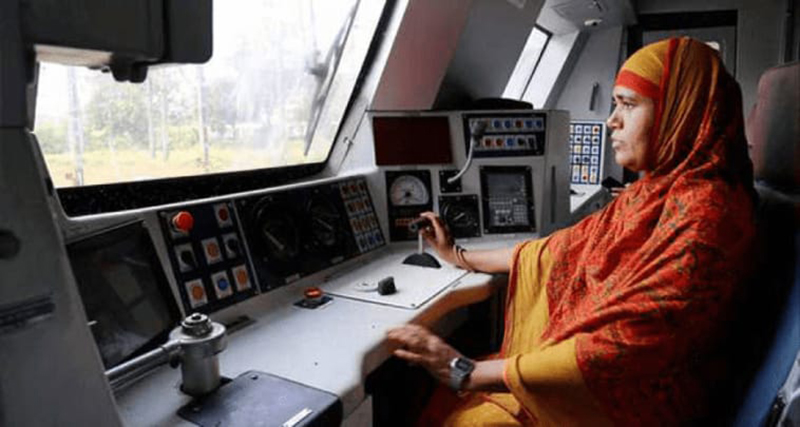
In 1989, after graduating from Seth Anandilal Podar High School in Santacruz, without wasting time she applied for the post of an engine driver. It wasn’t long before she made history. At the age of 20, in 1991, Mumtaz began driving trains, which was practically ground-breaking for a woman in India, much less someone from a conservative family.
Her skills and determination immediately drew the notice of her peers and superiors, and she was named Asia's first female locomotive driver by the Limca Book of Records in 1995. This feat was a turning point of her life not just in her career but also in the history of Indian Railways.
Mumtaz's career hit the roof as she proved herself in one of the toughest circumstances. In 2005, she was promoted from Assistant Loco Pilot (ALP) on diesel engines to Second Motorwoman (SM). This promotion was particularly noteworthy because it put her in charge of local trains on the Chhatrapati Shivaji Maharaj Terminus (CST) to Thane stretch, which is one of India's most crowded railway routes.
Mumtaz expertly navigated this path for nearly two decades, winning the respect and admiration of both her colleagues and the general public. Her services were recognized, and in 2015, she received the Railway General Manager Award, solidifying her legacy in the railways.
However, it was her attainment of the Nari Shakti Puraskar that cemented her status as a pathfinder. The Nari Shakti Puraskar is one of India's most prestigious prizes, honoring women who have made outstanding contributions to their disciplines.
Mumtaz's award from President Dr. Pranab Mukherjee was not just a personal triumph, but also a symbolic victory for women across India who want to break free from cultural restraints and pursue their aspirations.
Balancing a hard career with her home life was obviously difficult, but Mumtaz handled it gracefully. She married Maqsood Kazi, an electrical engineer, and they had two children. Her ability to excel in her work while also being a loving wife and mother displays her perseverance and determination.
Mumtaz M. Kazi's path is more than just a professional accomplishment; it is a story of breaking down boundaries, challenging society standards, and paving the way for future generations.
Her life is an example to women in India and everyone willing to dream big and work hard to accomplish those objectives. Mumtaz's accomplishments show that gender does not restrict success and that with determination, anything is achievable.
Support Our Journalism
We cannot do without you.. your contribution supports unbiased journalism
IBNS is not driven by any ism- not wokeism, not racism, not skewed secularism, not hyper right-wing or left liberal ideals, nor by any hardline religious beliefs or hyper nationalism. We want to serve you good old objective news, as they are. We do not judge or preach. We let people decide for themselves. We only try to present factual and well-sourced news.
Support objective journalism for a small contribution.