 Paper cups, Microplastic pollution
Is it safe to drink hot tea from paper cups? IIT Kharagpur research warns of microplastic pollution
Kharagpur (West Bengal)/IBNS: Has the time arrived to do a rethink on consuming hot liquids, such as tea, from disposable paper cups, the use of which has gone up manifold during the pandemic crisis?
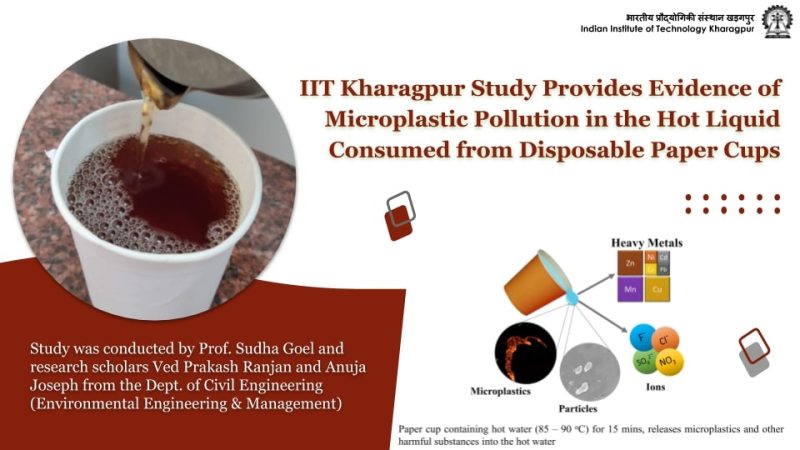
Recent research by IIT Kharagpur has confirmed contamination of the hot liquid served in paper cups due to the degradation of microplastics and other hazardous components from the lining material of the cup.
Paper cups are usually lined by a thin layer of hydrophobic film which is made of mostly plastic (polyethylene) and sometimes co-polymers to hold the liquid in the paper cup.
Within 15 minutes this microplastic layer degrades as a reaction to hot water, says the first of its kind study conducted in India by Dr. Sudha Goel, Associate Professor at the Dept. of Civil Engineering and research scholars Ved Prakash Ranjan and Anuja Joseph studying Environmental Engineering and Management.
“According to our study, 25,000 micron-sized (10 µm to 1000 µm) microplastic particles are released into 100 mL of hot liquid (85 – 90 oC) residing in the paper cups for 15 mins. Thus, an average person drinking 3 regular cups of tea or coffee daily, in a paper cup, would be ingesting 75,000 tiny microplastic particles which are invisible to the human eyes,” says Prof. Sudha Goel.
.jpg)
The researchers followed two different procedures - in the first process, hot ultrapure (MilliQ) water (85–90 ◦C; pH~6.9) was poured into the disposable paper cups, and it was allowed to sit for 15 mins.
The homogeneously mixed water was then analyzed for the presence of microplastics as well as additional ions that may have leached into the liquid from the paper cups.
In the second process, paper cups were initially dipped in lukewarm (30–40 °C) MilliQ water (pH~6.9).
Thereafter the hydrophobic film was carefully separated from the paper layer and exposed to hot MilliQ water (85–90 °C; pH~6.9) for 15 mins.
Changes in the physical, chemical, and mechanical properties of the plastic films were examined before and after exposure to hot water.
Explaining the exposure of 15 minutes, Prof. Goel linked its basis to a survey wherein the respondents confirmed consuming their beverage within 15 mins of obtaining it.
“Besides the result of the survey, it was also observed that within this time, the beverage attained the ambient temperature,” she said.
These microplastics can act as carriers for contaminants like ions, toxic heavy metals such as Palladium, Chromium, and Cadmium, and organic compounds that are similarly hydrophobic in nature thus allowing them to conveniently cross over to the animal kingdom, according to the researchers.
When ingested, the health implications could be serious.
Wondering whether traditional earthen products can be a more suitable replacement for such disposable items, Prof. Virendra K Tewari, Director, IIT Kharagpur said, “This study shows that careful consideration needs to be done before the promotion of replacements for bio-hazardous products and environmental pollutants. We have been quick to replace plastics cups and glasses with disposable paper cups. While the need was crucial we have to find eco-friendly products. India has traditionally been a country promoting a sustainable lifestyle and maybe it is time that we look into our roots for corrective measures.”
Support Our Journalism
We cannot do without you.. your contribution supports unbiased journalism
IBNS is not driven by any ism- not wokeism, not racism, not skewed secularism, not hyper right-wing or left liberal ideals, nor by any hardline religious beliefs or hyper nationalism. We want to serve you good old objective news, as they are. We do not judge or preach. We let people decide for themselves. We only try to present factual and well-sourced news.
Support objective journalism for a small contribution.