 Starlink
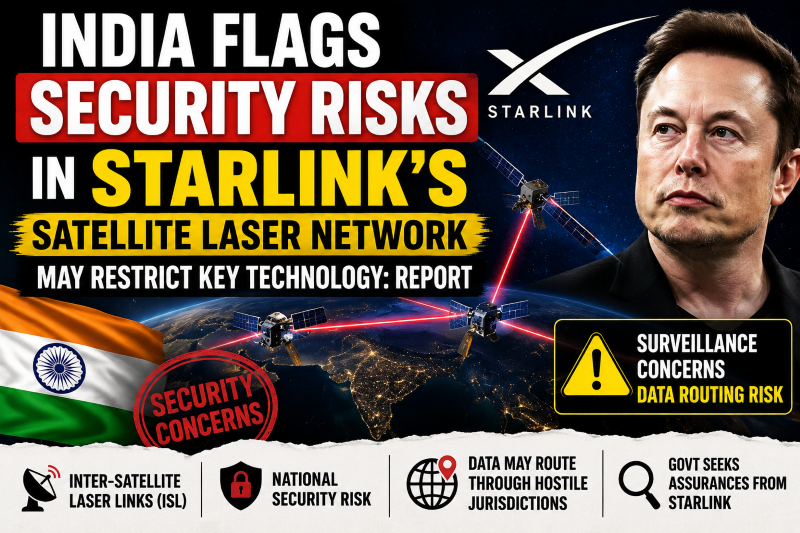
India flags security risks in Starlink's Satellite Laser network, may restrict key technology: Report
New Delhi/IBNS: The Indian government is unlikely to permit billionaire Elon Musk's Starlink to use a key satellite technology that allows its spacecraft to beam data directly to one another in space, citing surveillance and national security concerns, according to an Economic Times report.
The technology, known as Inter-Satellite Laser Links (ISLs), enables Starlink satellites to communicate with each other and create a mesh network above Earth without relying solely on ground stations.
Security Agencies Flag Surveillance Risks
Government officials have reportedly expressed concerns that the technology could result in data involving Indian users being routed through foreign jurisdictions, including potentially hostile territories or surveillance hubs, before reaching its intended destination.
Such routing could pose challenges for India's security agencies in monitoring and regulating data flows, the report said.
Govt Seeks Assurances From Starlink
The matter has been raised with Starlink, and the government is seeking guarantees that Indian user data will not be transmitted through routes that could compromise national security interests.
According to the report, data links on older Starlink satellites that do not have laser-link capabilities may either be disabled or subjected to restrictions for traffic involving Indian users.
Starlink Attempts to Address Concerns
While Indian authorities continue to scrutinise the technology, Starlink—owned by SpaceX—has reportedly sought to reassure the government that its network architecture does not pose a threat to national security and can be aligned with India's regulatory requirements.
What Are Inter-Satellite Laser Links?
Inter-Satellite Laser Links (ISLs) are advanced optical communication systems that allow satellites to transmit data directly to one another using laser beams. The technology reduces dependence on ground-based infrastructure and enables faster, more efficient global internet coverage.
Starlink uses ISLs to build a space-based mesh network, allowing data to travel across satellites before being delivered to users on the ground.
While this improves connectivity, especially in remote areas and oceans, governments worldwide have raised concerns about data sovereignty, regulatory oversight and the ability to monitor cross-border data flows.
India has been particularly cautious about satellite communication services, insisting on strict compliance with data localisation, lawful interception and national security requirements before granting full operational clearances to foreign satellite internet providers.
Support Our Journalism
We cannot do without you.. your contribution supports unbiased journalism
IBNS is not driven by any ism- not wokeism, not racism, not skewed secularism, not hyper right-wing or left liberal ideals, nor by any hardline religious beliefs or hyper nationalism. We want to serve you good old objective news, as they are. We do not judge or preach. We let people decide for themselves. We only try to present factual and well-sourced news.
Support objective journalism for a small contribution.