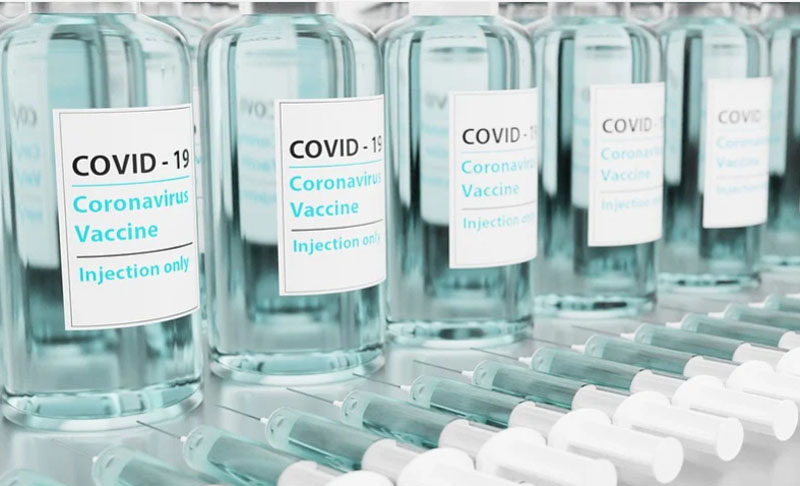
 Pfizer-Astrazaneca
Vaccine antibody levels start to wane at around 2-3 months: Study
London: Total antibody levels appear to start declining from as early as six weeks after complete vaccination and can reduce by more than 50% over 10 weeks, according to new data from UCL’s Virus Watch study.
These findings were consistent across all groups of people regardless of age, chronic illnesses or sex.
The findings, published as a research letter* in The Lancet, include data from over 600 people and show antibody levels are substantially higher following two doses of the Pfizer vaccine than after two doses of the AZ vaccine. They are also much higher in those with prior SARS-CoV-2 infection.
The authors highlight that although the clinical implications of waning antibody levels are not yet clear, some decline was expected and current research shows that vaccines remain effective against severe disease.
For Pfizer, antibody levels reduced from a median of 7506 U/mL at 21–41 days, to 3320 U/mL at 70 or more days. For Astra Zeneca, antibody levels reduced from a median of 1201 U/mL at 0–20 days to 190 U/mL (67–644) at 70 or more days.
Dr Maddie Shrotri (UCL Institute of Health Informatics) said: “The levels of antibody following both doses of either the Astra Zeneca or Pfizer vaccine were initially very high, which is likely to be an important part of why they are so protective against severe COVID-19.
“However, we found these levels dropped substantially over the course of 2 -3 months. If they carry on dropping at this rate, we are concerned that the protective effects of the vaccines may also begin to wear off, particularly against new variants; but we cannot yet predict how soon that might happen.”
Professor Rob Aldridge (UCL Institute of Health Informatics) explained: “When we are thinking about who should be prioritised for booster doses our data suggests that those vaccinated earliest, particularly with the Astra Zeneca vaccine, are likely to now have the lowest antibody levels.
Our findings support recommendations from the Joint Committee on Vaccination and Immunisation (JCVI) that adults who are clinically vulnerable, those aged 70 years or over, and all residents of care homes for older adults should be prioritised for booster doses. In addition, those who were vaccinated with the Astra Zeneca vaccine, including most care home residents, are likely to have much lower antibody levels than those vaccinated with the Pfizer vaccine, so this may also need to be considered when deciding who should be prioritised when boosters are rolled out.”
The authors note that limitations of the data include a small sample size for some groups and the fact that each individual only contributed one sample, so they cannot yet confirm how quickly antibody levels drop for each individual, or whether these would continue to drop or reach a stable level over the next few months. They also note different people will have different levels of immunity depending on the virus neutralising ability of their antibodies as well as their T-cell responses; and even when measurable antibody levels are low there is likely to be continuing immune memory that could offer long-term protection.
Further research will be important to establish if there is an antibody level threshold needed for protection against severe disease. The authors will continue to collect and analyse data from a larger number of participants, following antibody levels in individuals over a longer period of time.
Professor Andrew Hayward (UCL Epidemiology and Health Care) added: We know vaccines are excellent at preventing severe disease, but they are not perfect, and our data suggest protection will wane over time. With rapidly increasing COVID-19 rates and predictions of very high rates over the next weeks and months it is important that those who are clinically vulnerable, whose antibody levels may now have dropped continue to be cautious.
“When we are planning vaccination programmes around the world we need to take waning immunity and the likely need for booster doses into account - with limited global vaccine supply we need to balance protecting our most vulnerable through booster doses with ensuring we play a central role in supporting global vaccination efforts.
Support Our Journalism
We cannot do without you.. your contribution supports unbiased journalism
IBNS is not driven by any ism- not wokeism, not racism, not skewed secularism, not hyper right-wing or left liberal ideals, nor by any hardline religious beliefs or hyper nationalism. We want to serve you good old objective news, as they are. We do not judge or preach. We let people decide for themselves. We only try to present factual and well-sourced news.
Support objective journalism for a small contribution.