


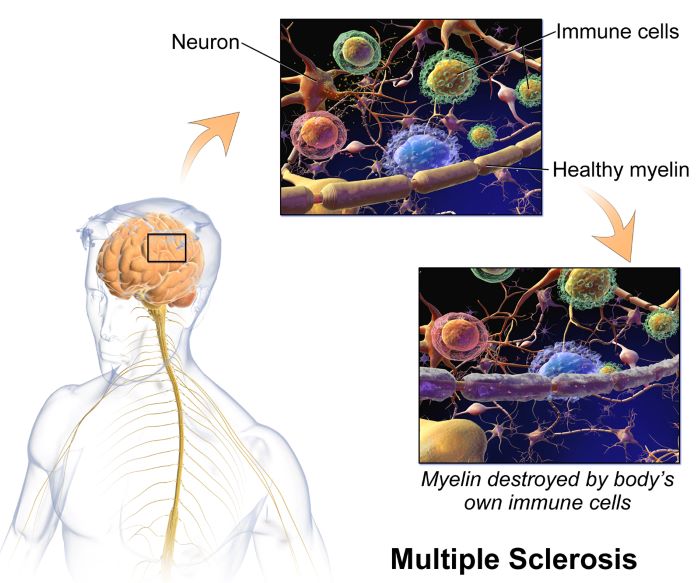
 Multiple Sclerosis
Scientists fabricate protein that can help study diseases like multiple sclerosis
Guwahati: A group of Indian scientists has fabricated monolayers of pure myelin basic protein (MBP), a major protein component of the myelin sheath, which is a protective membrane that wraps around the axon of nerve cells and acts as a model protein in studying diseases like multiple sclerosis (MS), Ministry of Science & Technology said on Friday.
A research group from the physical sciences division of the Institute of Advanced Study in Science and Technology used a technique called the Langmuir-Blodgett (LB) technique to form monolayers of pure myelin basic protein at the air-water and air-solid interfaces.
MBP helps in the compactification of the myelin sheath, and the fabricated tailored monolayers can give an in-depth understanding of the role of MBP in forming multi-lamellar myelin sheath structure as well as preserving the integrity, stability, and compactness of the sheath.
The research group led by Associate Professor Dr. Sarathi Kundu along with Senior Research Fellow Raktim J. Sarmah have explained the mechanism of the formation of MBP while tracking the stability and rigidity of the protein films by tuning the subphase pH conditions.
The reversible nature of the molecules confirms the flexibility of the films with respect to the pH conditions.
The behaviour of the protein under variable pH conditions was investigated from different areas of the monolayer formed at the air-water interface.
The rigidity of the monolayers was correlated with the specific domains formed and the area occupied by the domains on the water surface.
The closely packed MBP layer formed in the air-water and also on solid surfaces fabricated by the LB method will be helpful in studying different chemical and physical properties in 2D in the vicinity of the protein environment.
The deposited LB films of MBP may also be considered as protein nanotemplates to crystallize proteins of interest. This research work was recently published in the journal of Colloids and Surfaces A: Physicochemical and Engineering Aspects under the reputed Elsevier publishers.
Institute of Advanced Study in Science and Technology is an autonomous institute of North-East India under the Department of Science and Technology.
Support Our Journalism
We cannot do without you.. your contribution supports unbiased journalism
IBNS is not driven by any ism- not wokeism, not racism, not skewed secularism, not hyper right-wing or left liberal ideals, nor by any hardline religious beliefs or hyper nationalism. We want to serve you good old objective news, as they are. We do not judge or preach. We let people decide for themselves. We only try to present factual and well-sourced news.
Support objective journalism for a small contribution.


