Presence of the elusive snow leopard in Sikkim now confirmed through photographic evidence
Snow leopard, one of the rare and endangered members of the cat family, is difficult to locate as it is a highly elusive animal.
Poachers kill the animal for its pelt.
in Sikkim, WWF-India was collaborating with the armed forces, local communities and the state's forest department for better monitoring and conservation initiatives to study the snow leopard.
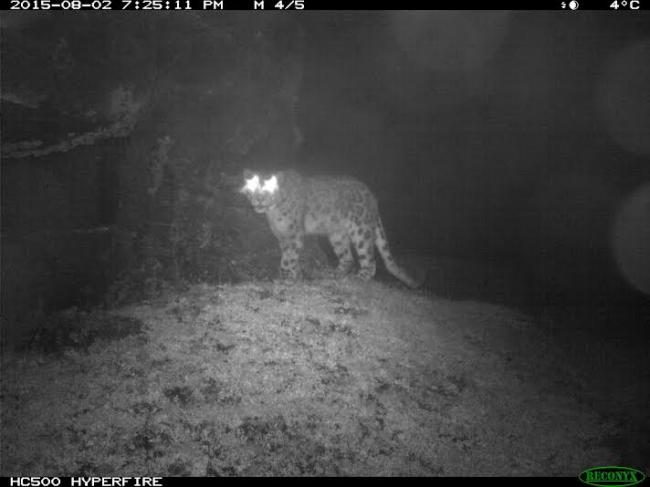
In a press release issued on Wednesday, WWF-India said that a pilot effort to set up camera traps in the North Sikkim plateau to understand the occurrence of snow leopards in the region has yielded results with the first photos of the elusive cat being captured at four different locations in North Sikkim.
Earlier, interactions with yak herders, known as ‘Dokpas’, had given valuable information on the presence of snow leopards in the high altitudes of North Sikkim area, and these camera trap photographs have now provided the first ever tangible evidence of their existence there.
In addition to snow leopards, the camera traps have also captured other mountain wildlife such as the rare pallas cat, blue sheep and the Tibetan argali. It has also provided visual documentation on free-ranging dogs and the areas they move in.
The snow leopard, a flagship species of the high altitudes, is a Schedule I animal under the Wildlife Protection Act of India and is listed as ‘endangered’ by the IUCN.
The camera trap study will be implemented across the entire potential distribution range in Sikkim in multiple phases. Several local youths from the village of Lachen who are engaged in this exercise, have been enthused and motivated by the latest findings.
Dr. Dipankar Ghose, director of the Species and Landscapes programme, explained, “Addressing retaliatory killing of snow leopards due to livestock depredation, managing the population of free ranging dogs and securing livelihoods of local communities, especially by targeting the community resilience towards climate-induced changes, are the pillars of our conservation efforts in this region.”
Recognizing the need to engage with multiple stakeholders at multiple levels, WWF-India is working with the Indian Armed Forces to raise awareness on the fragile ecology of the Himalayas and involving them in wildlife monitoring programmes.
Together with the Lachen Dzumsa and the Lachen Tourism Development Committee, WWF-India is also initiating several natural resource management practices with a strong focus on waste management.
Responsible tourism is being promoted in the region to reduce pressures on the snow leopard habitats.
Rishi Kumar Sharma, Snow Leopard Coordinator, WWF-India, added, “With credible scientific information, WWF-India envisions a future where the snow leopards thrive in the high mountains and the local communities benefit from a resilient and productive ecosystem”.
Image: WWF-India
Support Our Journalism
We cannot do without you.. your contribution supports unbiased journalism
IBNS is not driven by any ism- not wokeism, not racism, not skewed secularism, not hyper right-wing or left liberal ideals, nor by any hardline religious beliefs or hyper nationalism. We want to serve you good old objective news, as they are. We do not judge or preach. We let people decide for themselves. We only try to present factual and well-sourced news.
Support objective journalism for a small contribution.