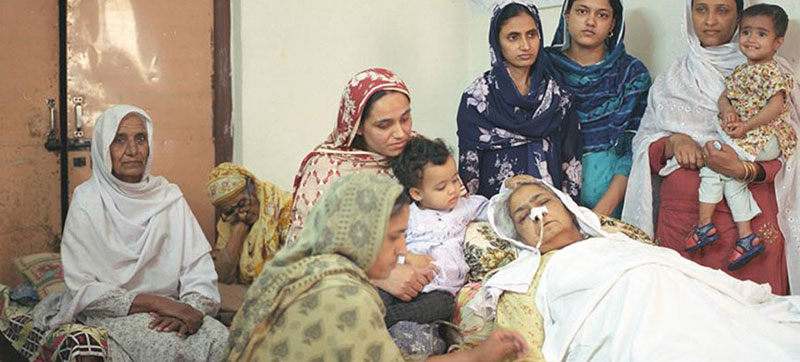
 Palliative Care
Only 1 in 10 people who need palliative care, receive it: WHO
New York: Only one in 10 people who need palliative care are receiving it, according to the World Health Organization (WHO).
The UN health agency says that global demand for care for people with life threatening illnesses, will continue to grow as populations age and the burden of noncommunicable diseases rises. By 2060, the need for palliative care is expected to nearly double.
To address this need, the agency released two new resources to support countries in assessing the development of palliative care and improving the quality of services.
Resources
One of the resources is a technical report with indicators that can be used by countries to monitor the provision of services. The goal is to create a global consensus on indicators, providing data that supports decision-making.
The second is a technical brief, that includes practical approaches and resources to support policy, strategy, and practice. The brief guides action at the national, district level, and point of care.
To date, the monitoring of palliative care services has been most often done by assessing the consumption of opioid analgesics. For WHO, though, opioids are only one component.
The agency believes that shared data across countries will provide a clearer picture of global needs and challenges, such as inequity. Measurement will also help identify success stories and best practices from other countries.
Each year, it is estimated over 56.8 million people, including 25.7 million in the last year of life, need palliative care. Around 78% of those people live in low and middle-income countries.
Pandemic
For WHO, the COVID-19 pandemic has highlighted the need for this type of care to relieve suffering at the end of life, such as the physical suffering caused by breathlessness, or mental pain.
The pandemic also reminded of the need for all health professionals to have some training in this area.
The agency argues that optimal care requires a supportive policy environment, empowered communities, palliative care research, access to essential palliative care medicines, strong education and training systems.
For WHO, “palliative care is a human right and a moral imperative of all health systems.”
The resources are being released in advance of World Hospice and Palliative Care Day, marked on 9 October 2021.
Support Our Journalism
We cannot do without you.. your contribution supports unbiased journalism
IBNS is not driven by any ism- not wokeism, not racism, not skewed secularism, not hyper right-wing or left liberal ideals, nor by any hardline religious beliefs or hyper nationalism. We want to serve you good old objective news, as they are. We do not judge or preach. We let people decide for themselves. We only try to present factual and well-sourced news.
Support objective journalism for a small contribution.