NASA spots single Methane leak from Space
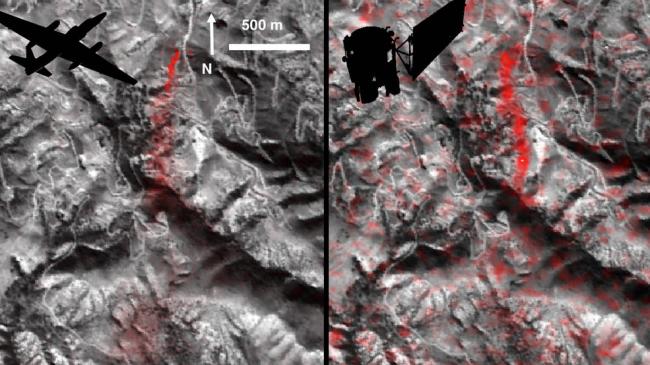
In a new paper accepted for publication in the journal Geophysical Research Letters, a research team with scientist David R. Thompson of NASA’s Jet Propulsion Laboratory, Pasadena, California, detailed the observation, which occurred over Aliso Canyon, near Porter Ranch, California. The Hyperion instrument successfully detected the methane leak on three separate overpasses during the winter of 2015-16. The research was part of an investigation of the large accidental Aliso Canyon methane release last fall and winter, read the NASA website.
The orbital observations from Hyperion were consistent with airborne measurements made by NASA’s Airborne/Infrared Imaging Spectrometer (AVIRIS) imager flying onboard a NASA ER-2 aircraft.
“This is the first time the methane emissions from a single facility have been observed from space,” said Thompson. “The percentage of atmospheric methane produced through human activities remains poorly understood. Future instruments with much greater sensitivity on orbiting satellites can help resolve this question by surveying the biggest sources around the world, so that we can better understand and address this unknown factor in greenhouse gas emissions.”
Other institutions participating in the study include Caltech, Pasadena, California; Helmholtz Centre Potsdam, GFZ German Research Centre for Geosciences, Potsdam, Germany; and NASA’s Goddard Space Flight Center, Greenbelt, Maryland.
Part of NASA’s New Millennium Program, EO-1 is an advanced land-imaging mission designed to demonstrate new instruments and spacecraft systems. Launched in 2000, EO-1 has validated technologies for the Operational Land Imager used on the Landsat-8 satellite mission and future imaging spectrometer missions, and supported disaster-response applications. The mission is managed by NASA Goddard. A joint initiative between NASA and the U.S. Geological Survey, Landsat represents the world’s longest continuously acquired collection of space-based moderate-resolution land remote sensing data.
Image Credits: NASA-JPL/Caltech/GSFC
Support Our Journalism
We cannot do without you.. your contribution supports unbiased journalism
IBNS is not driven by any ism- not wokeism, not racism, not skewed secularism, not hyper right-wing or left liberal ideals, nor by any hardline religious beliefs or hyper nationalism. We want to serve you good old objective news, as they are. We do not judge or preach. We let people decide for themselves. We only try to present factual and well-sourced news.
Support objective journalism for a small contribution.