September 25, 2026 09:00 am (IST)

Follow us:


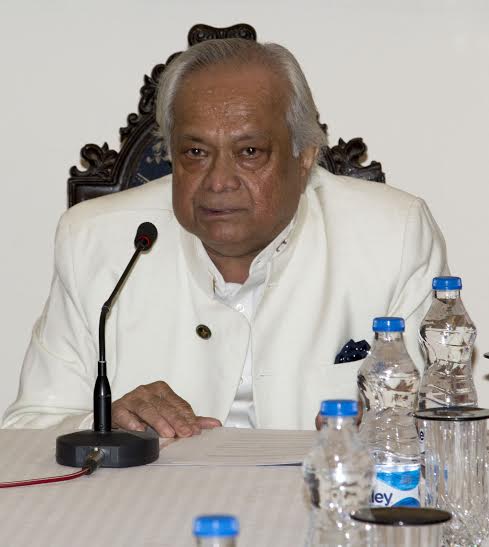
India should become a member of CERN: Scientist
Kolkata, Feb 8 (IBNS): Indian science and technology has moved forward and touched the international benchmark, said a noted globally known home physicist at conference here organized by the Saha Institute of Nuclear Physics and attended by some of the famous names in world science, including from Geneva-based CERN that proposed India to be its associate member at the earliest.
"This process of technology development had started when Manmohan Singh was the Prime Minister of India and still it is continuing very well," said physicist Bikash Sinha at one of the sessions recently.
Scientists like Horst Stocker, Johanna Satchel, Jurgen Schucraft, Rolf Heuer, Philip Parker, Larry McLarren, Peter Braun Munzinger and others participated at the 'International Conference on Physics and Astrophysics of Quark Gluon Plasma (ICPA-QGP)'.
This conference from Feb 2 to 6 at Saha Institute witnessed a discussion session with Homi Bhabha Professor Bikash Sinha on the theme 'India's international collaborations in Physical Sciences' at Bengal Club in Kolkata on Thursday last.
Bikash Sinha said that the technology and the ways of manipulating technology should be known very well.
The director general of Conseil Européen pour la Recherche Nucléaire (CERN/European Organization for Nuclear Research) Rolf Heuer said that India is not an associate member of CERN yet and it is very important for India to take membership.
"If India becomes an associate member of CERN, Indian scientists can do their experiments very well, they can take part directly in the international-level experiments, they can use developed machines and they can choose their own partners to collaborate," he added.
Bikash Sinha said that a country like Pakistan also got the membership of CERN and India would get that soon.
"Indian market of scientific products and thoughts are very good, but CERN doesn't buy anything unless you become its associate member," spokesperson of A Large Ion Collider Experiment (ALICE by CERN) Jurgen Schucraft concluded.
Bikash Sinha explained the Fundamental Structure of Matter to the journalists at the end of the programme.
Director of the Bose Institute and S.N.Bose Centre Kolkata, Sibaji Raha, and director of Variable Energy Cyclotron Centre (VECC) Kolkata Dinesh Srivastava were also present at the programme.
(Reporting by Deepayan Sinha, Images by Sounak Choudhury/IBNS)
Support Our Journalism
We cannot do without you.. your contribution supports unbiased journalism
IBNS is not driven by any ism- not wokeism, not racism, not skewed secularism, not hyper right-wing or left liberal ideals, nor by any hardline religious beliefs or hyper nationalism. We want to serve you good old objective news, as they are. We do not judge or preach. We let people decide for themselves. We only try to present factual and well-sourced news.
Support objective journalism for a small contribution.

Latest Headlines
Venus’ missing moon mystery solved? Scientists say the planet may have swallowed it
Sun, Sep 20 2026
Scientists find first adult T. Rex trackway—Here’s how fast the killer dinosaur moved
Mon, Sep 14 2026
ISRO’s ‘Naughty Boy’ delivers big win: GSLV-F17 launches EOS-05 in historic mission
Fri, Sep 04 2026
Look up, Kolkata! Telescope viewing, space shows and quiz coming to BITM this August
Wed, Aug 19 2026
What is Moon Base programme? NASA invites ISRO to join lunar mission
Wed, Aug 12 2026
24 hours after historic launch, Skyroot makes a bold claim about Vikram-1's success
Sun, Jul 19 2026