


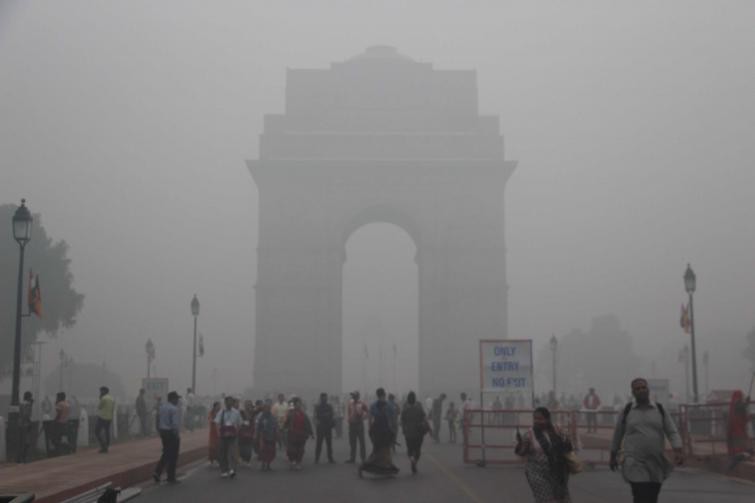
Delhi chokes as AQI slips to ‘severe’, smog blankets city
Delhi was shrouded in a thick haze on Sunday morning as air quality across the national capital slipped further into the ‘severe’ category.
According to data from the Central Pollution Control Board (CPCB), the Air Quality Index (AQI) stood at 462 at 6 am, reflecting extremely hazardous pollution levels.
All 40 air quality monitoring stations in the city reported ‘red’ readings, signalling severe air pollution. Rohini in northwest Delhi recorded an AQI of 499, the highest in the city, while Jahangirpuri and Vivek Vihar followed closely with AQI levels of 495.
The AQI is a public health indicator used to convey air pollution levels and their associated health risks.
It is calculated using eight key pollutants — PM10, PM2.5, ozone, sulphur dioxide, nitrogen dioxide, carbon monoxide, lead and ammonia — as defined by CPCB standards.
An AQI reading above 401 is classified as ‘severe’ and poses serious health risks, particularly to children, the elderly and those with respiratory conditions.
In view of the worsening situation, the Commission for Air Quality Management (CAQM) on Saturday enforced restrictions under the Graded Response Action Plan (GRAP)-3 and later escalated them to the stricter GRAP-4 level across Delhi-NCR.
These measures include curbs on construction activities, vehicular movement and industrial operations.
Officials told the media that the sharp deterioration in air quality was largely due to a weak Western Disturbance approaching north-west India, which has led to unfavourable meteorological conditions and reduced dispersion of pollutants.
Authorities clarified that local emission sources were not the primary trigger for the sudden spike in pollution levels.
If you’d like, I can also tighten it further for print, add quotes, or adapt it for digital headlines and push alerts.
Support Our Journalism
We cannot do without you.. your contribution supports unbiased journalism
IBNS is not driven by any ism- not wokeism, not racism, not skewed secularism, not hyper right-wing or left liberal ideals, nor by any hardline religious beliefs or hyper nationalism. We want to serve you good old objective news, as they are. We do not judge or preach. We let people decide for themselves. We only try to present factual and well-sourced news.
Support objective journalism for a small contribution.


