600,000 children developing intellectual disabilities every year
The announcement was made in Washington DC on the occasion of Global Citizen 2015 Earth Day recently.
Achieving this target involves educating people of the severe health effects of lead poisoning on children less than 6 years of age and pregnant women. Childhood lead poisoning can have lifelong health impacts, including reduced IQs, learning disabilities, anemia and disorders in coordination, visual, spatial and language skills. In extreme cases, it can lead to hypertension and seizures. There is no blood lead level considered to be safe.
As per statistics by WHO, each year lead exposure contributes to an estimated 600,000 new cases of intellectual disabilities in children. The syndrome can, and should be prevented.
Toxics Link has been working closely with WHO and the European Union as a part of this alliance supporting national efforts to establish a regulatory framework to control the manufacture, trade and use of lead paints, informing the public about the hazards and consequences of lead exposure, and encouraging manufacturers to shift to lead free raw materials and paint formulations.
While substitutes for lead paint are cost effective and easily accessible, the use of leaded pigments in the paints for decorating homes, schools and children's toys is still permitted in numerous countries.
Paints that contains high-levels of lead additives poses a great risk of lead poisoning, especially for children and pregnant women. When lead paint is used in homes, schools and playgrounds, young people are directly and constantly exposed to high levels of lead from paint chips and in dust or soil.
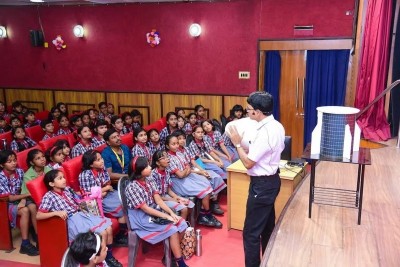
“After gasoline, household paints are the second largest source of exposure to lead poisoning. Children are most vulnerable to the health effects due to lead poisoning. Health issues like lack of concentration, learning disability and stomach cramps might be taken as normal indigestion but it can be due to elevated blood lead levels which cause serious non-reversible damage. Only stringent standards can prevent use of lead in paints to same our coming generations,” said Mr. Satish Sinha, Associate Director, Toxics Link.
GAELP is a cooperative initiative jointly led by the World Health Organization (WHO) and the United Nations Environment Programme.
Support Our Journalism
We cannot do without you.. your contribution supports unbiased journalism
IBNS is not driven by any ism- not wokeism, not racism, not skewed secularism, not hyper right-wing or left liberal ideals, nor by any hardline religious beliefs or hyper nationalism. We want to serve you good old objective news, as they are. We do not judge or preach. We let people decide for themselves. We only try to present factual and well-sourced news.
Support objective journalism for a small contribution.