


 Chandrayaan-3
Chandrayaan-3: With lander Vikram making it to lunar surface, rover Pragyan will now take over
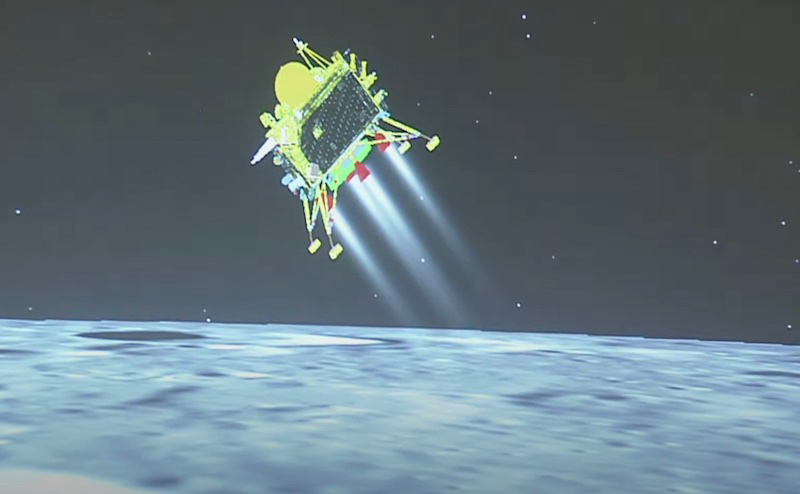
As the lander Vikram of India's Chandrayaan-3 mission soft-landed on the Moon, marking a historic day for India and the world, the rover Pragyan will now roll out from the lander to carry out its mission.
Prior to landing, imaging of the landing site was done for locating safe and hazard-free zones.
The success of this Moon mission has made India the fourth country to master the technology of soft landing on the lunar surface after the US, China, and the erstwhile Soviet Union.
Lander Vikram's final touchdown speed was well within its safe limits. Four engines ran initially. Two of them were shut down later and therefore the touchdown on the lunar surface was powered by two engines.
The lander kicked up a large cloud of Moondust when it landed on the surface. The dust will not settle down anytime soon due to the extremely weak gravitational force the Moon exerts but will scatter away on its own momentum.
The rover Pragyan will emerge from the lander three-and-a-half hours after the touched down on the lunar surface near the Moon's South Pole. India is the first country to land a spacecraft near the lunar South Pole.
The Indian Space Research Organisation (ISRO) did not want the fine Moon dust to coat the cameras and other sensitive instruments, so it decided to wait for over three hours to ensure the dust moved away from the lander Vikram.
"The rover will come out in a few hours. Sometimes it takes a day also... Once the rover comes out, it will do two experiments. We are looking at a very exciting time after Pragyan's entry... It will do experiments for 14 days," Somnath had told reporters in the euphoric moments after the landing.
The rover Pragyan will first extend its solar arrays and roll out with a wire connected to the lander Vikram. The wire will be snapped once the rover is stable on the lunar surface. It will then start its scientific mission.
Support Our Journalism
We cannot do without you.. your contribution supports unbiased journalism
IBNS is not driven by any ism- not wokeism, not racism, not skewed secularism, not hyper right-wing or left liberal ideals, nor by any hardline religious beliefs or hyper nationalism. We want to serve you good old objective news, as they are. We do not judge or preach. We let people decide for themselves. We only try to present factual and well-sourced news.
Support objective journalism for a small contribution.


