 Semicon India
Semicon India 2025 sends message 'world trusts India, world believes in India': PM Modi
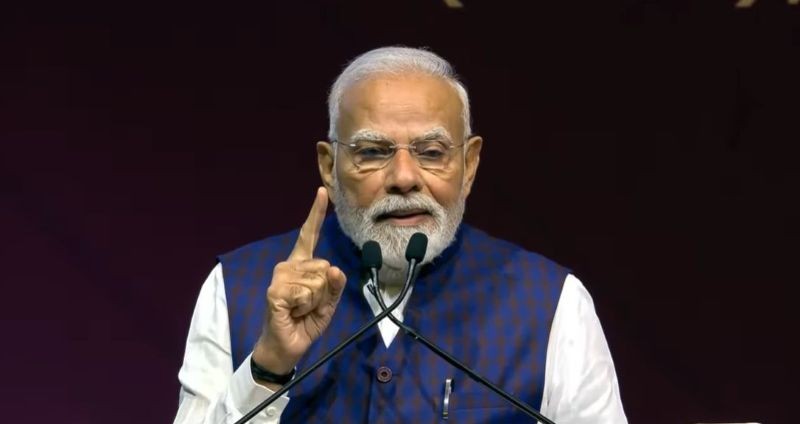
New Delhi/IBNS: Prime Minister Narendra Modi on Tuesday boasted of "Viksit Bharat" and "Aatmanirbhar Bharat" at the Semicon India 2025.
Inaugurating the event, Modi, who returned from a Japan and China visit on Monday, said, "Semicon India 2025 sends a powerful message: the world trusts India, the world believes in India, and the world is ready to build the semiconductor future with India. I warmly welcome all of you. You are important partners in the journey of #ViksitBharat and #AtmanirbharBharat."
"The GDP numbers for the first quarter of this year have once again proven that Bharat has performed beyond every expectation and estimate," said Modi.
Other significant moments at the eventIn the backdrop of the India-US tariff war, the Prime Minister added, "On one hand, many of the world’s economies are facing uncertainty and challenges related to economic selfishness. Yet, in this environment, Bharat has achieved a remarkable growth rate of 7.8 percent. This growth is visible across all sectors, and it brings a unique enthusiasm to our citizens. With this momentum, we are well on our way to becoming the world’s third-largest economy."
- First Made-in-India Chip Presented: Modi received India’s first domestically produced semiconductor chip, marking a milestone in self-reliance.
- Indigenous “Vikram” Processor: Union Minister Ashwini Vaishnaw showcased India’s first fully indigenous 32-bit microprocessor, named “Vikram”, along with test chips from approved semiconductor projects.
- Vision for a $100–110 Billion Semiconductor Market by 2030: The PM projected that India’s semiconductor market could reach this scale as the ecosystem matures.
1. Strategic autonomy in tech
- Semiconductors are the backbone of everything from smartphones to fighter jets.
- By positioning India as a chip manufacturing and design hub, Modi is signaling that India doesn’t want to remain dependent on imports from Taiwan, South Korea, or the US.
- This reduces vulnerability in crises (e.g., supply shocks during US–China tensions or Taiwan conflict).
- The semiconductor war is at the heart of U.S.–China competition.
- The U.S. is pushing for “friend-shoring” chip supply chains away from China.
- India is emerging as a preferred partner for Washington, Japan, South Korea, and the EU—strengthening India’s geopolitical leverage.
- Japan and the U.S. are already investing in Indian fabs and design centers.
- India’s chip strategy strengthens the Quad’s technological pillar, giving the grouping teeth in tech security.
- It allows India to negotiate with more bargaining power in trade deals and defense partnerships.
- Chips need rare earths and critical minerals (like lithium, cobalt, gallium).
- India’s semiconductor ambition is pushing it to forge new partnerships in Africa, Latin America, and Australia—reshaping its foreign policy priorities.
- This creates new South–South cooperation pathways outside China’s Belt and Road framework.
- Modi’s line “Designed in India, Made in India, Trusted by the World” is a direct soft-power push.
- It seeks to place India alongside Taiwan, Japan, and the U.S. as a trusted democracy-led tech hub.
- That’s an image battle against China’s authoritarian supply chain dominance.
- A robust semiconductor ecosystem could add tens of billions to India’s GDP, strengthen exports, and make India less dependent on oil-driven economies.
- Economic strength directly translates into greater geopolitical bargaining power in global forums like the G20, WTO, and UN.
- Chips aren’t just about phones—they power missiles, satellites, AI, and cybersecurity.
- India’s push signals to rivals (China, Pakistan) that it aims to indigenize critical defense technology.
- It reduces risks of sanctions or supply cutoffs during conflicts.
Support Our Journalism
We cannot do without you.. your contribution supports unbiased journalism
IBNS is not driven by any ism- not wokeism, not racism, not skewed secularism, not hyper right-wing or left liberal ideals, nor by any hardline religious beliefs or hyper nationalism. We want to serve you good old objective news, as they are. We do not judge or preach. We let people decide for themselves. We only try to present factual and well-sourced news.
Support objective journalism for a small contribution.