 Iran War
Hormuz flashpoint: Iran targets Western shipping — Could India escape a global oil shock?
Amid escalating tensions in the Gulf, Iran has announced that the Strait of Hormuz will remain closed only to vessels belonging to the United States, Israel, Europe and their Western allies.
The statement, delivered by Iran’s Islamic Revolutionary Guard Corps (IRGC) through state broadcaster IRIB on Thursday, has triggered global attention as the narrow waterway plays a decisive role in the movement of energy supplies, including those critical to India’s economy.
The development comes after several days of uncertainty surrounding the strait, one of the world’s busiest maritime corridors.
Commercial traffic has slowed dramatically since hostilities erupted in the region, prompting energy markets and governments worldwide to monitor the situation closely.
Iran warns Western vessels
In its statement, the IRGC asserted that Iran retains the right to regulate passage through the Strait of Hormuz during wartime.
The Guards emphasised that this authority stems from international laws and relevant resolutions governing maritime conduct during armed conflicts.
The statement warned that any vessels belonging to the United States, Israel, European countries or their supporters entering the strait could face direct military action.
Iranian authorities described the restrictions as part of wartime control measures rather than a blanket closure of the channel.
Iranian officials reiterated that the Islamic Republic had previously made clear its position regarding control of maritime traffic in the strait during periods of conflict.
According to the IRGC, such measures fall within Iran’s rights as a coastal state overseeing one side of the critical maritime passage.
Gulf conflict fuels global energy concerns
The announcement follows a surge in tensions after the United States and Israel launched a joint military operation against Iran earlier this week.
Since the beginning of the hostilities, the Strait of Hormuz has effectively remained inactive for most commercial shipping, largely due to security risks and uncertainty.
Oil markets reacted quickly to the developments. Prices surged as traders feared potential disruptions to global energy flows.
The Strait of Hormuz carries nearly one-fifth of the world’s seaborne oil, making it one of the most strategically sensitive shipping routes on the planet.
For India, which relies heavily on imported crude oil, any disruption in Gulf shipping routes carries significant implications.
A large share of India’s crude imports originates from Middle Eastern producers, many of whose exports pass through this narrow corridor.
Selective access and China’s role
Earlier in the week, Iranian authorities indicated that vessels flying the Chinese flag would be allowed to use the strait.
Officials described the move as a gesture of appreciation towards Beijing’s diplomatic stance since the conflict began.
The decision highlighted the geopolitical dimension of maritime access in the region.
By allowing Chinese vessels to pass while restricting Western ones, Iran appeared to signal strategic alignment with certain global powers while confronting others involved in the conflict.
The Strait of Hormuz is the only maritime outlet for ports located in the Persian Gulf, making it indispensable for energy exporters in the region.
Any restrictions or disruptions in the waterway immediately ripple through global oil markets and international trade routes.
Shipping slowdown and global supply chain strain
Despite Iran’s selective restrictions, most commercial vessels have avoided the strait since the fighting intensified.
Ship captains and shipping companies have largely opted to halt movement rather than risk entering a conflict zone.
This caution has placed pressure on global supply chains.
Many companies now face the challenge of managing logistics without access to a route that has long served as a cornerstone of global energy transport.
Data from maritime tracking platforms indicates that numerous tankers remain stationary in the northern Gulf, particularly near Kuwait and along the coast close to Dubai.
More vessels have gathered near the entrance to the Strait of Hormuz, waiting for clarity before proceeding.
Iran’s own merchant ships are reportedly anchored near the port of Bandar Abbas, located on the eastern side of the strait.
The accumulation of vessels in surrounding waters illustrates the scale of disruption currently affecting maritime activity in the region.
Strategic importance of Strait of Hormuz
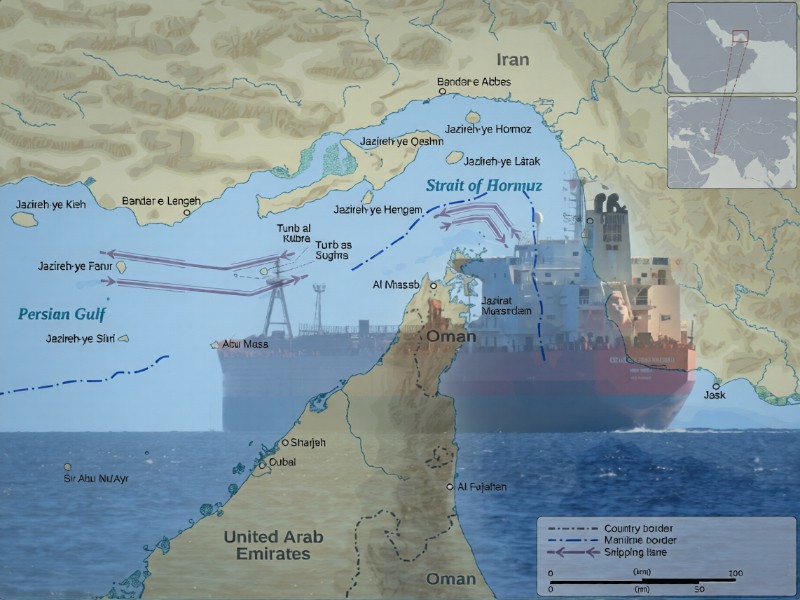
The Strait of Hormuz links the Persian Gulf with the Gulf of Oman and the wider Arabian Sea.
Its narrow channel serves as the primary route for oil exports from major producers such as Saudi Arabia, Iraq, Kuwait and the United Arab Emirates.
Although analysts note that the strait’s closure would not block the main east-west shipping lanes between Asia and Europe, it would severely affect energy exports from Gulf countries.
As a result, global markets closely track any signs of instability in the waterway.
The Persian Gulf itself functions almost like a maritime cul-de-sac, bordered by the coastlines of Iran, Iraq and Kuwait. Without access through the Strait of Hormuz, exports from several major ports in the region would face severe limitations.
One key example is Dubai’s Jebel Ali port, the world’s tenth-largest container terminal and a central distribution hub serving more than a dozen countries.
Access to this facility also depends on uninterrupted passage through the strait.
A rare disruption
Historically, the Strait of Hormuz has remained open to commercial shipping even during periods of intense regional conflict.
During the Iran-Iraq war from 1980 to 1988, for instance, merchant vessels continued to navigate the route despite repeated attacks on oil tankers in what became known as the “Tanker War”.
The current situation therefore represents an unusual disruption to one of the most vital maritime corridors in global trade.
While Iran has not declared a universal closure of the waterway, the ongoing conflict and heightened security risks have already significantly slowed traffic.
For India and other energy-importing economies, developments in the Strait of Hormuz remain a matter of strategic importance.
With global oil supply chains closely tied to this narrow channel, the unfolding situation continues to draw close attention from governments, shipping companies and energy markets worldwide.
Support Our Journalism
We cannot do without you.. your contribution supports unbiased journalism
IBNS is not driven by any ism- not wokeism, not racism, not skewed secularism, not hyper right-wing or left liberal ideals, nor by any hardline religious beliefs or hyper nationalism. We want to serve you good old objective news, as they are. We do not judge or preach. We let people decide for themselves. We only try to present factual and well-sourced news.
Support objective journalism for a small contribution.