 Trade Deal
Historic India-US trade pact: Tariffs cut, $500B market opportunity unlocked!
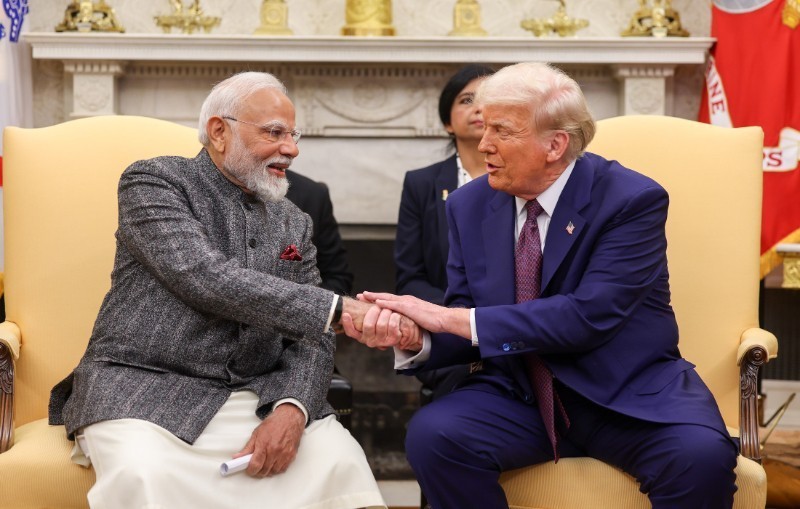
Washington DC/New Delhi/IBNS: The United States and India have finalized a framework for an interim trade deal, days after US President Donald Trump announced the long-delayed pact that has injected fresh momentum into the two countries’ strained bilateral ties, media reports said.
The framework was finalized after nearly a year of negotiations. Since taking office, Trump had taken a tough stance against India over alleged unfair trade practices and its purchase of Russian oil.
As previously announced by Trump, the US has reduced the overall 50% tariff—comprising 25% counter-tariffs and the rest linked to Russian oil purchases—to 18%, providing relief for Indian traders.
India’s Commerce Minister Piyush Goyal announced on X: "As part of this framework, the US will slash reciprocal tariffs on Indian goods to 18%, providing a huge market opportunity in key sectors such as textiles & apparel, leather & footwear, plastic & rubber products, organic chemicals, home décor, artisanal products, and select machinery in the world’s largest economy.
"Additionally, tariffs will go down to zero on a wide range of goods, including generic pharmaceuticals, gems & diamonds, and aircraft parts, thereby further enhancing India’s export competitiveness and Make in India."
"India will also get exemptions under Section 232 on aircraft parts, tariff rate quotas on auto parts, and negotiated outcomes on generic pharmaceuticals, leading to tangible export gains in these sectors," he added.
Under the decisive leadership of PM @NarendraModi ji, India has reached a framework for an Interim Agreement with the US. This will open a $30 trillion market for Indian exporters, especially MSMEs, farmers and fishermen. The increase in exports will create lakhs of new job… pic.twitter.com/xYSjxML6kt
— Piyush Goyal (@PiyushGoyal) February 7, 2026
The agreement also states that India intends to purchase $500 billion of US energy products, aircraft and aircraft parts, precious metals, technology products, and coking coal over the next five years.
Hailing the agreement, Prime Minister Narendra Modi thanked President Trump for his "personal commitment" to strengthening India-US ties, saying the framework reflects the “growing depth, trust, and dynamism of our partnership.”
"It strengthens ‘Make in India’ by opening new opportunities for India’s hardworking farmers, entrepreneurs, MSMEs, startup innovators, fishermen, and more. It will generate large-scale employment for women and youngsters," Modi added.
Great news for India and USA!
— Narendra Modi (@narendramodi) February 7, 2026
We have agreed on a framework for an Interim Trade Agreement between our two great nations. I thank President Trump for his personal commitment to robust ties between our countries.
This framework reflects the growing depth, trust and dynamism of… https://t.co/zs1ZLzamhd
However, India did not confirm whether it has stopped purchasing oil from Russia, a claim recently made by the White House. Russia responded, saying India is free to purchase oil from any country.
Kremlin spokesperson Dmitry Peskov told Russian news agency TASS: “India is free to buy oil from whomever it wants. Along with other international energy experts, we are well aware that Russia is not the only supplier of oil and petroleum products to India. India has always purchased these products from other countries. Therefore, we see nothing new here.”
India, which relies on overseas sources for nearly 88% of its crude oil needs, meets about one-third of its requirement through imports from Russia. However, it reduced its Russian oil purchases to around 1.1 million barrels per day in the first three weeks of January, down from 1.21 million barrels per day in the previous month and over 2 million barrels per day in mid-2025, following Trump’s additional 25% tariffs on New Delhi, according to real-time analytics firm Kpler, as quoted by NDTV.
Support Our Journalism
We cannot do without you.. your contribution supports unbiased journalism
IBNS is not driven by any ism- not wokeism, not racism, not skewed secularism, not hyper right-wing or left liberal ideals, nor by any hardline religious beliefs or hyper nationalism. We want to serve you good old objective news, as they are. We do not judge or preach. We let people decide for themselves. We only try to present factual and well-sourced news.
Support objective journalism for a small contribution.