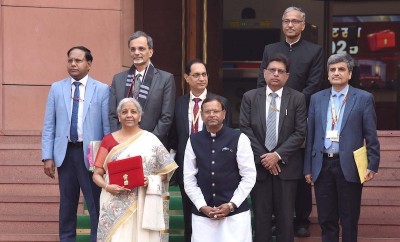
Economic Survey emphasizes need to improve agricultural productivity
This is the fourth highest quantity of annual Foodgrains production in the country. Despite deficiency of 12 % in the monsoon rainfall during the year, the loss in production has been restricted to just around 3 % over the previous year and has exceeded the average production during the last five years by 8.15 million tonnes.
As compared to last year’s production of 265.57 million tonnes, current year’s production of Foodgrains is lower by 8.5 million tonnes. This decline has occurred on account of lower production of rice, coarse cereals and pulses due to erratic rainfall conditions during the monsoon season of 2014.
According to the new series of national income released by the CSO, at 2011-12 prices, the share of agriculture and allied sectors in total GDP is 18% in 2013-14 which is the same as that of 2012-13 i.e., 18%. As against a growth target of 4% for agriculture and allied sectors in the Twelfth Plan, the growth registered in the first year in 2012-13 (at 2011-12 prices) was 1.2%, 3.7% in 2013-14 and 1.1% in 2014-15.
As per the fourth Advance Estimates for 2013-14, the production of rice is expected to be 106.5 million tonnes, showing an increase of 1.3% over the previous year. The Production of wheat is likely to be 95.9 million tonnes with an increase of 2.6% over the previous year. Similarly, pulses with a production of 19.3 million tonnes show an increase of 5.3%. The oilseeds production of 32.9 million tonnes shows an increase of 6.4%. Within oilseeds, the groundnut production of 9.7 million tonnes show a commendable increase of 105.8% over the previous year.
As per the fourth Advance Estimates for 2013-14, the overall productivity of Foodgrains has gone down by 1.3% over the previous year. Rice productivity has shown a decline of 1.5% and wheat of 1.3% in the same year. The yield of groundnut increased by a remarkable 75.9%, that of Tur increased by 9.2% and cotton by 9.4% in 2013-14 over the previous year.
Among the states, for the year 2013-14, Punjab has shown the highest productivity of rice (3952 kg/ha), wheat (5017 kg/ha) and cotton. Gujarat has shown the maximum productivity of groundnut (2668 kg/ha) and West Bengal of Sugarcane (114273 kg/ha).
The Economic Survey 2014-15 states that to improve resilience of the agricultural sector and bolster food security--including availability and affordable access, the strategy for agriculture has to focus on improving yield and productivity.
Support Our Journalism
We cannot do without you.. your contribution supports unbiased journalism
IBNS is not driven by any ism- not wokeism, not racism, not skewed secularism, not hyper right-wing or left liberal ideals, nor by any hardline religious beliefs or hyper nationalism. We want to serve you good old objective news, as they are. We do not judge or preach. We let people decide for themselves. We only try to present factual and well-sourced news.
Support objective journalism for a small contribution.