 Cabinet
Cabinet approves Minimum Support Prices for all Rabi Crops for Marketing Season 2023-24
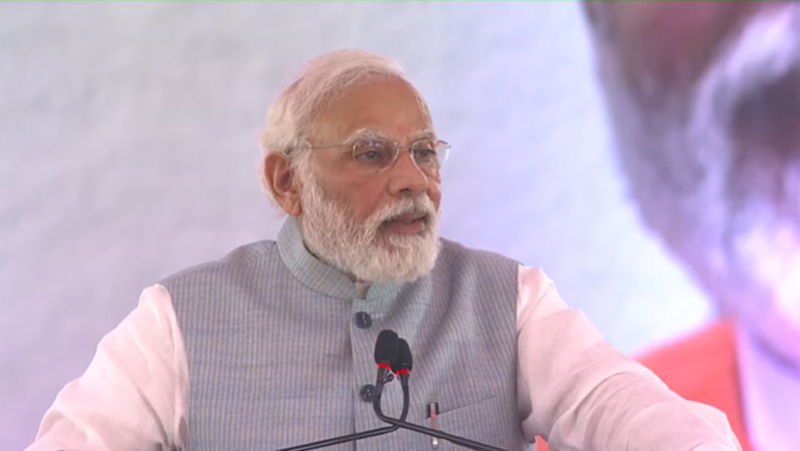
New Delhi: The Cabinet Committee on Economic Affairs chaired by Prime Minister Narendra Modi has approved the increase in the Minimum Support Prices (MSP) for all mandated Rabi Crops for Marketing Season 2023-24.
Government has increased the MSP of Rabi Crops for Marketing Season 2023-24, to ensure remunerative prices to the growers for their produce.
The absolute highest increase in MSP has been approved for lentil (Masur) at Rs.500/- per quintal followed by rapeseed and mustard at Rs.400/- per quintal, read a government statement.
For safflower, an increase of Rs.209/- per quintal has been approved.
For wheat, gram and barley an increase of Rs.110/- per quintal, Rs.100 per quintal respectively has been approved.
The increase in MSP for Rabi Crops for Marketing Season 2023-24 is in line with the Union Budget 2018-19 announcement of fixing the MSP at a level of at lease 1.5 times of the All-India weighted average Cost of Production, aiming at reasonably fair remuneration for the farmers.
The maximum rate of return is 104 percent for rapeseed & mustard, followed by 100 percent for wheat, 85 per cent for lentil; 66 per cent for gram; 60 per cent for barley; and 50 per cent for safflower.
From the year 2014-15, there has been a renewed focus on increasing the production of oilseeds and pulses. The efforts have yielded good results. Oilseeds production has increased from 27.51 million tonnes in 2014-15 to 37.70 million tonnes in 2021-22 (4th advance estimates). Pulses production has shown similar increasing trend. The Seed Minikits programme is a major tool for introducing new varieties of seeds in the farmers’ fields and is instrumental for increasing the seed replacement rate.
The productivity of pulses and oilseeds have increased substantially since 2014-15. In case of pulses productivity has been increased from 728 kg/ha (2014-15) to 892 kg/ha (4th Advance estimates, 2021-22) i.e. 22.53% increase. Similarly, in oilseed crops productivity has been increased from 1075 kg/ha (2014-15) to 1292 kg/ha (4th Advance estimates, 2021-22).
The Government’s priority is on increasing production of oilseeds and pulses and thus fulfilling the objective of Atmanirbhar Bharat. The formulated strategies are to increase production through area expansion, productivity through High Yielding Varieties (HYVs), MSP support and procurement.
Government is also promoting adoption of smart farming methods through the use of technology and innovation in the agriculture sector in the country.
Government is implementing a Digital Agriculture Mission (DAM), which includes India Digital Ecosystem of Agriculture (IDEA), Farmers Database, Unified Farmers Service Interface (UFSI), Funding to the States on the new Technology (NeGPA), Revamping Mahalnobis National Crop Forecast Centre (MNCFC), Soil health, Fertility and profile mapping. Under the NeGPA programme, funding is given to State Governments for Digital Agriculture projects using emerging technologies like Artificial Intelligence and Machine Learning (AI/ML), Internet of Things (IOT), Block chain etc. Adoption of drone technologies is being done. To promote smart farming, the Government also promotes Startups in the Agriculture sector and nurtures agri-entrepreneurs.
Support Our Journalism
We cannot do without you.. your contribution supports unbiased journalism
IBNS is not driven by any ism- not wokeism, not racism, not skewed secularism, not hyper right-wing or left liberal ideals, nor by any hardline religious beliefs or hyper nationalism. We want to serve you good old objective news, as they are. We do not judge or preach. We let people decide for themselves. We only try to present factual and well-sourced news.
Support objective journalism for a small contribution.