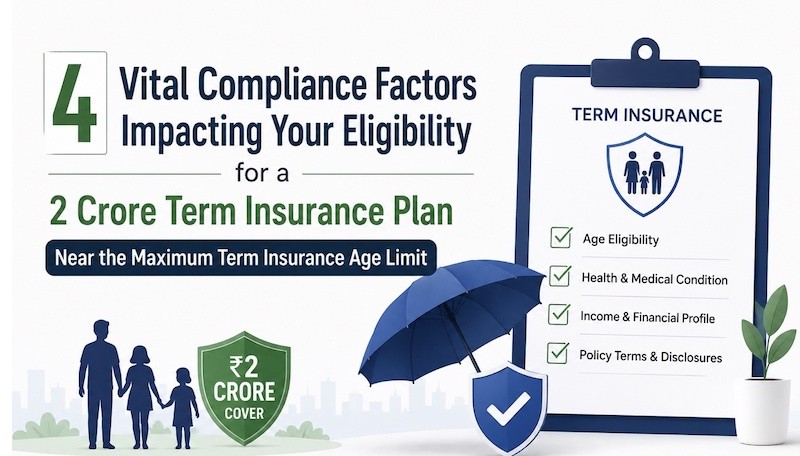
4 Vital Compliance Factors Impacting Your Eligibility for a 2 Crore Term Insurance Plan Near the Maximum Term Insurance Age Limit
Buying term insurance when young is straightforward. You are healthy, the paperwork is simple, and approvals rarely take long.
But apply for a large cover like a 2 crore term insurance plan closer to the upper end of the age bracket, and things get more detailed. Insurers check more, ask more questions, and several compliance factors come into play that can affect whether you get approved, at what price, or with what conditions.
Understanding these factors before applying saves time and avoids surprises.
First, a Quick Note on Term Insurance Age Limit
Every term plan has an entry age range. Most insurers in India allow entry from 18 years, and the maximum entry age typically sits between 60 and 65, though a few plans extend to 70.
The term insurance age limit is not just about entry. It also determines how long your cover can run. Enter at 58 with a maximum coverage age of 75, and your available policy term is short. At 35, you could hold the same plan for 40 years.
Applying near the maximum term insurance age limit means a narrower coverage window. For a high cover like 2 crore term insurance, insurers scrutinise applications much more carefully at this stage.
Here are four compliance factors that matter most.
Factor 1: Medical Underwriting Gets Stricter
At younger ages, some insurers approve term plans without a medical test, especially for modest cover amounts. That changes as you get older.
Near the term insurance age limit, medical underwriting becomes mandatory for most insurers, especially for a 2 crore term insurance plan. Tests typically required include:
● A complete blood panel
● Blood pressure and ECG readings
● Urine tests
● Liver and kidney function reports
● A chest X-ray in some cases
Any flag in these tests can lead to a loading on the premium, a specific exclusion, or an outright decline.
The compliance point here: existing health conditions that were manageable at 40 may carry more weight at 58. Insurers recalibrate risk differently as age increases.
Factor 2: Financial Underwriting for High Cover Amounts
A 2 crore term insurance payout is a large sum. Insurers do not approve high cover amounts without checking whether it is financially justified.
This is called financial underwriting, and it gets tighter as you approach the maximum entry age.
What they typically look at:
|
Document |
Purpose |
|
Income Tax Returns (last 3 years) |
Proof of income level |
|
Salary slips or business financials |
Validates current earning capacity |
|
Net worth statement |
Used for self-employed applicants |
|
Existing insurance policies |
Checks total cover already in force |
The rule of thumb here is that total life coverage must not go above ten to fifteen times your income. In case you have an existing policy and the total coverage exceeds this limit, then the 2 crore application will certainly undergo close scrutiny.
Near the age limit, this ratio is reviewed with less flexibility.
Also read: Understanding High-Value Home Insurance and Risk
Factor 3: Declaration of All Existing Policies
When you apply for a fresh 2 crore term insurance plan near the upper age limit, you must declare all existing life insurance policies. This is a compliance requirement, not optional.
Why does it matter?
Insurers cross-verify declarations through the Insurance Information Bureau, a central repository tracking all policies issued across companies. Any mismatch between what you declare and what the bureau shows can delay or reject your application.
At older ages, applicants often hold multiple older policies such as endowment or money-back plans. All of them need to be declared.
Failing to declare even a dormant or lapsed policy is treated as non-disclosure, which can cause claim complications later.
Factor 4: Lifestyle and Occupational Risk Disclosure
Lifestyle and occupation compliance holds true for all age groups, although it becomes more important as one approaches the term insurance age limit. Such aspects as smoking, tobacco consumption, or excessive alcohol consumption become re-assessed for older individuals.
It is important to mention smoking even if you began smoking after purchasing the last policy. It is very risky to try hiding this information, as any test will uncover tobacco usage, regardless of the information mentioned on the form.
Occupation also gets reviewed more carefully:
● High-risk jobs involving physical danger, travel to conflict zones, or chemical exposure attract higher premiums at older ages
● Some occupations may result in exclusions for accidental death under specific conditions
● Desk-based roles face no such issues, but declarations still need to be accurate
Misrepresentation in any of these areas, even unintentional, can invalidate a claim after the policyholder's death, at the exact point when the 2 crore payout was supposed to protect the family.
Also read: How to Protect Your Business with Comprehensive Insurance Plans
A Quick Summary of the Four Factors
|
Compliance Factor |
Why It Matters Near Age Limit |
|
Medical Underwriting |
More tests, stricter evaluation of existing conditions |
|
Financial Underwriting |
High cover needs income justification |
|
Existing Policy Declaration |
All policies must be disclosed accurately |
|
Lifestyle and Occupation |
Habits and job risk carry more weight at older ages |
What You Can Do Before Applying
● Get a full health check done before applying, so there are no surprises during the insurer's tests
● Gather income proof covering the last three years
● List all active and lapsed insurance policies you currently hold
● Be accurate about smoking, drinking, and any change in occupation since your last policy
Taking these proactive steps streamlines the application process and prevents unexpected claim rejections later. Having this documentation ready ensures a smoother medical underwriting experience, giving you total peace of mind that your family's coverage is built on accurate, solid ground.
Final Thought
A 2 crore term insurance plan near the maximum term insurance age limit is achievable. But the path to approval is more detailed than it would be at 35.
None of the four factors above are unfair. They reflect genuine risk that insurers need to account for. Going in prepared, with honest disclosures and complete documentation, gives your application the best shot at first-attempt approval.
Support Our Journalism
We cannot do without you.. your contribution supports unbiased journalism
IBNS is not driven by any ism- not wokeism, not racism, not skewed secularism, not hyper right-wing or left liberal ideals, nor by any hardline religious beliefs or hyper nationalism. We want to serve you good old objective news, as they are. We do not judge or preach. We let people decide for themselves. We only try to present factual and well-sourced news.
Support objective journalism for a small contribution.