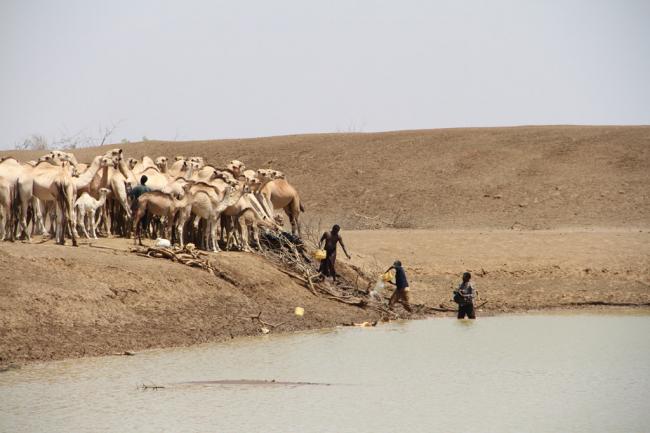
UN urges 'reboot' of drought responses to focus more on preparedness
“People die because they are not prepared to face the impacts of the drought – because their livelihoods are not resilient enough,” Food and Agriculture Organization (FAO) Director-General José Graziano da Silva told an international seminar in Rome, Italy, recalling that more than 250,000 people perished from hunger in the 2011 drought in Somalia.
“Saving livelihoods means saving lives – this is what building resilience is all about,” he added, noting that for years, the focus has been responding to droughts when they happen, rushing to provide emergency assistance and to keep people alive.
While these emergency responses are important, investing in preparedness and resilience puts countries on a footing to act quickly before it is too late, meaning that farmers and rural communities are better positioned to cope with extreme weather when it does hit.
The need for a global drought re-boot is pressing. The many impacts of drought drive not only hunger and instability but cause economic losses up to $8 billion each annually.
As the planet's climate changes, severe dry-spells are becoming more and more frequent. Since the 1970s, the land area in the world affected by situations of drought has doubled.
The burden is especially high in developing countries, where agriculture remains an economic mainstay. Over 80 percent of damage and losses caused by drought are born by agriculture in the developing world, FAO studies have shown.
And Africa in particular has borne the brunt. Between 2005 and 2016, 84 droughts affected 34 different African nations.
At on Monday's event, FAO and the World Meteorological Organization (WMO) signed a memorandum of understanding to deepen their cooperation. They will cooperate in improving agro-meteorological data, tools and methods as well as enhancing access by small farmers to products and services to help them anticipate and proactively prepare for droughts.
“WMO provides guidance and scientific information to strengthen national services responsible for addressing drought risks to agriculture,” said WMO Secretary General Petteri Taalas. “We encourage countries to take early action against drought and to move towards a more proactive approach.”
International Fund for Agriculture Development (IFAD) President Gilbert F. Houngbo in his remarks emphasized the need break the cycle of crisis, disaster and relief, calling on the international community to be proactive and to think not just of on Monday's emergencies, but also of how to prevent tomorrow's.
“This means investing in smallholder farmers to help them address productivity challenges, give them access to markets and finance and most importantly encourage climate-smart agriculture so that when the drought inevitably comes, they have the tools they need to survive and thrive,” said Houngbo.
Photo: Rita Maingi/ OCHA
Source: www.justearthnews.com
Support Our Journalism
We cannot do without you.. your contribution supports unbiased journalism
IBNS is not driven by any ism- not wokeism, not racism, not skewed secularism, not hyper right-wing or left liberal ideals, nor by any hardline religious beliefs or hyper nationalism. We want to serve you good old objective news, as they are. We do not judge or preach. We let people decide for themselves. We only try to present factual and well-sourced news.
Support objective journalism for a small contribution.