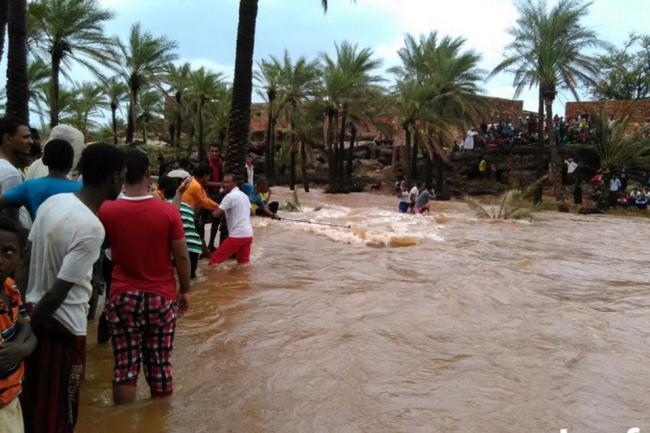
'Severe impact' feared in Yemen due to rain potential of cyclone Chapala
“Our big fear about this cyclone is the rainfall potential here,” said Clare Nullis, spokesperson for the World Meteorological Organization (WMO) speaking at a press briefingat UN Headquarters in Geneva.
“There have been various reports that Yemen could get the equivalent of six years…the equivalent of ten years of rainfall, it’s actually very difficult to quantify it,” she continued.
She added, “I think the main point to underline is that Yemen is normally very arid, it doesn’t have the infrastructure to cope, so we really do expect this cyclone to have a very significant impact.”
Cyclone Chapala made landfall in Yemen while fighting between the Government and rebel Houthi forces in the country continues. Since March 2015, the crisis has been an all-out conflict, with a military operation launched by a coalition led by Saudi Arabia.
Amid the violence, many Yemenis are now receiving a “crash course” on how to cope with the cyclone, Nullis explained.
She further noted that that the country doesn’t have a functioning meteorological service or an observation network – making is challenging for WMO to know how much rain Yemen will get, and to assess what it happening.
Meanwhile, World Health Organization (WHO) spokesperson Fadela Chaib said that the UN health agency and the Yemeni Ministry of Public Health and Population are intensifying efforts to respond to the effects of cyclone Chapala, which are expected to be more severe in Shabwah and Hadhramaut.
“[These areas] have a combined population of about 1.8 million people. This includes more than 100,000 internally displaced people and 27,000 refugees and migrants,” said Chaib.
“In preparation for the health impact of the cyclone, WHO has delivered trauma kits 1,000 patients in Mukalla district of Hadhramaut Governorate. The Organization is also providing 12,000 litres of diesel to eight hospitals to ensure their continuous functionality as well as 2,500 litres of petrol for 16 ambulances,” she added, noting that a Strategic Health Operation Centre was being established in the WHO Office in Sana’a.
Asked about casualties, Chaib said that no information is available at the moment, and stressed the importance of preparedness to ensure that health facilities are functioning and that information is available to facilitate appropriate emergency response.
She also indicated that given the “challenging situation” in Yemen, WHO will be relying on national non-governmental organizations and the Ministry of Public Health to ensure that aid is provided in places where needs are more acute, given their knowledge of the area and accessible routes.
Photo: UNICEF Yemen/Ahmed Tani
Support Our Journalism
We cannot do without you.. your contribution supports unbiased journalism
IBNS is not driven by any ism- not wokeism, not racism, not skewed secularism, not hyper right-wing or left liberal ideals, nor by any hardline religious beliefs or hyper nationalism. We want to serve you good old objective news, as they are. We do not judge or preach. We let people decide for themselves. We only try to present factual and well-sourced news.
Support objective journalism for a small contribution.