Identifying all-time deadliest weather events, UN says history can help mitigate future disasters
“Extreme weather causes serious destruction and major loss of life. That is one of the reasons behind the WMO's [World Meteorological Organization] efforts to improve early warnings of multiple hazards and impact-based forecasting, and to learn lessons gleaned from historical disasters to prevent future ones,” said WMO Secretary-General Petteri Taalas.
“The human aspect inherent in extreme events should never be lost,” he added.
While the in-depth investigation by a WMO expert committee documented mortality records for five specific weather-related events, it did not address heat- or cold-waves, drought and floods.
The experts found that the highest mortality rate associated with extreme weather was during a 1970 tropical cyclone through what was at the time East Pakistan, which killed an estimated 300,000 people.
Other record-breaking weather events included a 1989 tornado in Bangladesh that killed an estimated 1,300 people, destroying the Manikganj district; a 1994 lightning-caused oil tank fire in Dronka, Egypt, which took 469 lives, whiled 21 people were killed by a single lightning bolt to a hut in the Manica Tribal Trust Lands in what was then Rhodesia; and Meanwhile, a 1888 hailstorm in near Moradabad, India, which killed 246 people with hailstones as large as “goose eggs and oranges and cricket balls.”
The findings were announced ahead of two major conferences on improving multi-hazard early warning systems and strengthening disaster risk reduction, taking place in Cancun, Mexico from 22 to 26 May and organized by WMO and the UN Office on Disaster Risk Reduction (UNISDR).
“These events highlight the deadly tragedies associated with different types of weather. Detailed knowledge of these historical extremes confirms our continuing responsibilities to not only forecast and monitor weather and climate but to utilize that information to save lives around the world so disasters of these types are lessened or even eliminated in the future,” said Randall Cerveny, WMO Rapporteur on Climate and Weather Extremes.
The experts stressed that vulnerability is a function of both the risk of an event and the adaptation or resilience to the event. For example, heatwave-related mortality tends to decrease as air conditioning becomes more widespread. Similarly, lightning casualties decrease when munitions storage facilities install lightning rods and athletic programs establish lightning safety protocols.
Overall mortality can also decrease as a result of continuous improvement in related forecasting and warning infrastructure. For example, the MeteoAlarm system in Europe is a web-based service designed to provide real-time warning for people travelling in Europe of severe weather.
“Yet even with these improvements, mortality from weather-related events will continue. In order to put potential future weather-related catastrophes into accurate historical context, it is useful to have knowledge of baseline changes in weather-related mortality as monitored over the last one hundred and fifty years of official international weather records,” said the WMO committee.
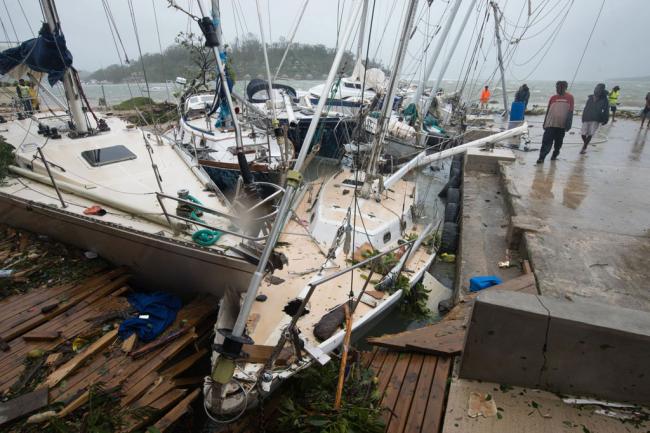
Photo: UNICEF Pacific/Alice Clements
Source: www.justearthnews.com
Support Our Journalism
We cannot do without you.. your contribution supports unbiased journalism
IBNS is not driven by any ism- not wokeism, not racism, not skewed secularism, not hyper right-wing or left liberal ideals, nor by any hardline religious beliefs or hyper nationalism. We want to serve you good old objective news, as they are. We do not judge or preach. We let people decide for themselves. We only try to present factual and well-sourced news.
Support objective journalism for a small contribution.