FEATURE: Does drone technology hold promise for the UN?
Although this technology is not a magic solution, “the promise of drones is really tremendous,” said Christopher Fabian, principal advisor on innovation at the UN Children’s Fund (UNICEF), in an interview with UN News.
For UNICEF and other humanitarian and development agencies, he said, drone technology can make a big difference in three ways.
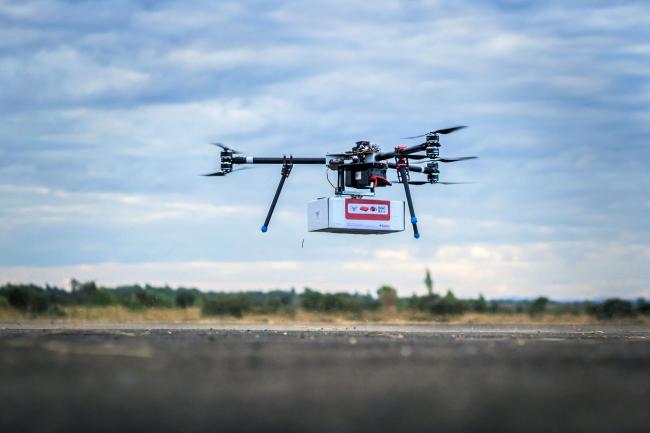
First, drones can leapfrog over broken infrastructure in places where developed transportation networks or roads do not exist, carrying low-weight supplies.
Second, UAVs can be used for remote sensing, such as gathering imagery and data, in the wake of natural disasters like mudslides, to locate where the damage is and where the affected peoples are.
Third, drones can extend WiFi connectivity, from the sky to the ground, providing refugee camps or schools with access to the Internet.
As big as a Boeing 737 passenger jet and as small as a hummingbird, a huge variety of drones exist. According to research firm Gartner, total drone unit sales climbed to 2.2 million worldwide in 2016, and revenue surged 36 per cent to $4.5 billion.
Although UNICEF’s use of drones has been limited, the agency is exploring ways to scale up the use of UAVs in its operations, Fabian said.
In late June, Malawi, in partnership with UNICEF, launched Africa’s first air corridor to test the humanitarian use of drones in Kasungu District.
Also with UNICEF, Vanuatu has been testing the capacity, efficiency and effectiveness of drones to deliver life-saving vaccines to inaccessible, remote communities in the small Pacific island country.
Vanuatu is an archipelago of 83 islands separated over 1,600 kilometres. Many are only accessible by boat, and mobile vaccination teams frequently walk to communities carrying all the equipment required for vaccinations – a difficult task given the climate and topography.
To extend the use of drones, UNICEF and the World Food Programmes (WFP) have formed a working group. In addition, UNICEF, together with the Office of the UN High Commissioner for Refugees (UNHCR), chairs the UN Innovation Network, an informal forum that meets quarterly to share lessons learned and advance discussions on innovation across agencies.
Drones are also used in other parts of the UN system. The International Atomic Energy Agency (IAEA) and its partners have introduced a new quadcopter drone to visually map gamma radiation at Japan’s Fukushima Daiichi nuclear plant, which was damaged by the devastating 2011 tsunami.
Last year, an IAEA-supported drone won fourth place in the 2016 United Arab Emirates Drones for Good Award competition, which received over 1,000 entries from more than 160 countries.
ROMEO, or the Remotely Operated Mosquito Emission Operation, met the competition’s aim of improving people’s lives. It was designed to transport and release sterile male mosquitoes as part of an insect pest birth control method that stifles pest population growth.
Some UN peacekeeping missions, such as those in the Democratic Republic of the Congo, Mali and the Central African Republic, have deployed unarmed surveillance UAVs to improve security for civilians.
Drone technology, however, can be a double-edged sword. UN human rights experts have spoken out against the lethal use of drones.
“Hardware itself does not violates human rights. It is the people behind the hardware,” said Fabian, stressing the need to “make sure that any technology we bring in or work on falls within the framing of rights-based documents,” such as the Convention on the Rights of the Child.
UNICEF has a set of guiding principles for innovation, which includes elements like designing with the end-user.
For drone applications to spread further, Fabian said, the UN has a strong role in advocating this technology and ensuring that policy is shared with different governments.
In addition, governments have to clearly define why they need drones and what specifically they will be used for, while also building up national infrastructure to support their use.
The private sector must understand that the market can provide them real business opportunities.
In 10 to 20 years, drones might be “as basic to us as a pen or pencil,” said Fabian.
“I believe this technology will go through a few years of regulatory difficulty but will eventually become so ubiquitous and simple that it’s like which version of the cell phones you have rather than have you ever use the mobile phone at all,” he said.
Photo: UNICEF/UN070227/Chim Chisiza
Source: www.justearthnews.com
Support Our Journalism
We cannot do without you.. your contribution supports unbiased journalism
IBNS is not driven by any ism- not wokeism, not racism, not skewed secularism, not hyper right-wing or left liberal ideals, nor by any hardline religious beliefs or hyper nationalism. We want to serve you good old objective news, as they are. We do not judge or preach. We let people decide for themselves. We only try to present factual and well-sourced news.
Support objective journalism for a small contribution.