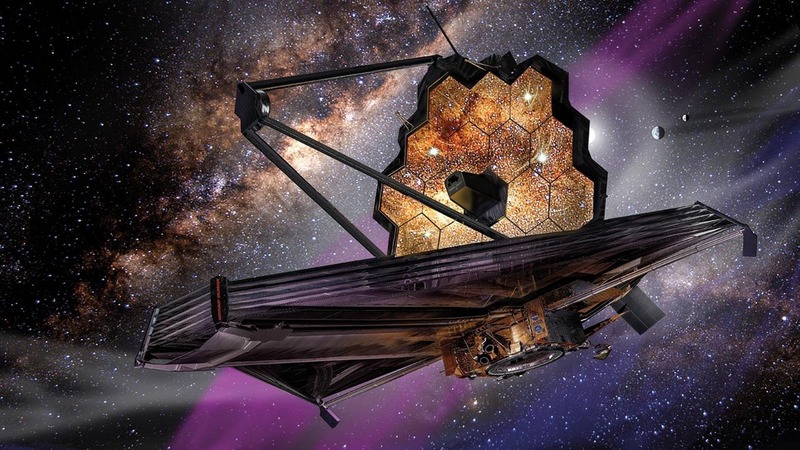
 James Webb Telescope
James Webb Telescope spots oldest-ever galaxy
Paris/IBNS: The James Webb Space Telescope has made a groundbreaking discovery by spotting the four farthest galaxies ever observed, according to new research released on Tuesday.
One of these galaxies was formed only 320 million years after the Big Bang, during the early stages of the universe.
This implies that the telescope is also witnessing events that occurred in the past, as it observes light that has travelled vast distances over millions of years.
The light emitted from the galaxies situated farthest away from Earth undergoes significant changes during its journey through space.
Due to the universe's expansion, the light waves get stretched out, causing a shift towards the infrared end of the light spectrum by the time it reaches our planet.
With the advanced detection capabilities of the NIRCam instrument on the Webb telescope, previously undiscovered galaxies emitting infrared light can be detected quickly.
These findings have the potential to significantly alter astronomers' comprehension of the early universe.
In two articles published in the Nature Astronomy journal, scientists announced their discovery of the four most remote galaxies ever detected with undeniable evidence.
These galaxies originated from a period 300 to 500 million years following the Big Bang, which occurred over 13 billion years ago when the universe was still in its infancy, accounting for just two percent of its present age.
These galaxies belonged to the "epoch of reionisation," a phase that followed the cosmic dark ages following the Big Bang, during which the first stars are thought to have emerged.
The farthest galaxy ever observed, JADES-GS-z13-0, was found to have formed 320 million years after the Big Bang. The Webb telescope also confirmed the existence of JADES-GS-z10-0, a galaxy that dates back 450 million years after the Big Bang.
All four galaxies are low in mass, but active in star formation at a surprising rate, considering their age, said Stephane Charlot, a researcher at the Astrophysics Institute of Paris and co-author of the two new studies, told AFP.
Moreover, they contain a low concentration of metals, consistent with the standard model of cosmology, she further stated.
Since its launch last year, the Webb telescope has enabled a deluge of scientific breakthroughs by gazing into the farthest corners of the universe.
Support Our Journalism
We cannot do without you.. your contribution supports unbiased journalism
IBNS is not driven by any ism- not wokeism, not racism, not skewed secularism, not hyper right-wing or left liberal ideals, nor by any hardline religious beliefs or hyper nationalism. We want to serve you good old objective news, as they are. We do not judge or preach. We let people decide for themselves. We only try to present factual and well-sourced news.
Support objective journalism for a small contribution.