


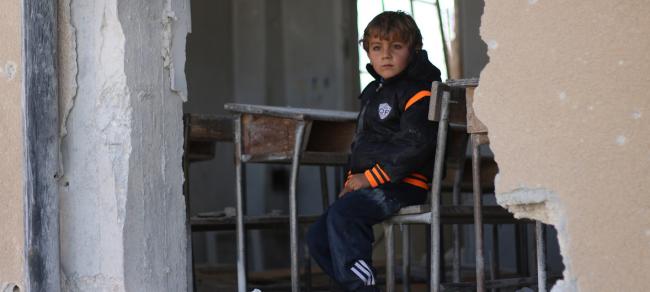
WFP and UNICEF prepare for the worst in Syria’s Idlib, as insecurity mars start of another school year
New York, Sept 8 (IBNS): Emergency food supplies for hundreds of thousands of people in Syria’s Idlib are “ready for distribution” in the event of mass displacement caused by a full-scale military offensive on the last opposition-held region, the World Food Programme (WFP) said on Friday.
Spokesperson Herve Verhoosel told journalists in Geneva that the UN agency has enough ready-to-eat food for 850,000 people for one week, but that the “single greatest priority” must be to end the conflict.
“WFP appeals to all parties to protect civilians, respect humanitarian principles and allow for the safe delivery of food to families in need, no matter where they are,” he said.
This food aid is either already inside Syria or can be brought in to the war-torn country from neighbouring Turkey. Additional supplies for displaced families can also be diverted from WFP’s monthly deliveries to Idlib, Aleppo and Hama, according to the WFP spokesperson.
“Sufficient” nutrition supplies are also in place for 180,000 children and women for up to three months, Mr Verhoosel explained, before adding that the more than seven-year war had left 6.5 million Syrians food insecure and another four million are at risk of becoming so - twice as many as last year.
And amid preparations for the potential mass displacement, UN Children’s Fund UNICEF warned that the conflict has caused an education crisis, affecting Syrian youngsters nationwide.
“Thousands of children in Idlib have been forced to leave their homes multiple times and are now living in overcrowded makeshift shelters, with food, water and medicine in dangerously short supply,” said Henrietta Fore, UNICEF Executive Director. “A fresh wave of violence could leave them trapped between fighting lines or caught in the crossfire, with potentially fatal consequences,” she added.
Even as the new school year started on 1 September, many schools are still lacking vital supplies, almost 7,000 classrooms are in need of rehabilitation, and over 2,300 teaching positions are currently vacant.
Four million children throughout the country were due to go back to school, but two million cannot. As fighting intensifies, UNICEF is gravely concerned that potential airstrikes, ground military operations, and the use of explosive weapons in densely populated areas will be disastrous for children, said Ms. Fore.
“Our request is simple: Protect children. Give us safe, sustained and unconditional access to them. Allow and enable those who want to leave to do so safely and voluntarily,” she added.
For UNICEF, education can help overcome trauma, foster reconciliation and repair a community’s social fabric. Despite these benefits, however, the task of getting children into school has been made harder owing to a shortfall of some 180,000 education workers nationwide.
In Idlib, where schools have been opening earlier than usual in an effort to provide more lesson time for some 400,000 children, “schooling is often suspended because of insecurity, shelling and violence”, UNICEF spokesperson, Christophe Boulierac said, briefing reporters in Geneva on Friday.
Outside Syria, education is also a major problem in refugee host countries, he added. “While the percentage of out-of-school children in these neighbouring countries dropped from 41 per cent in 2016 to 35 per cent in 2017, there continue to be 700,000 children out of school in the neighbouring countries.”
Faced with a severe funding shortfall amounting to $517 million, the UN agency fears that host governments in Turkey, Lebanon, Iraq and Egypt, “who have spared no effort” to accommodate Syrian children, could change policies that have kept schools open to refugees.
UNICEF
Support Our Journalism
We cannot do without you.. your contribution supports unbiased journalism
IBNS is not driven by any ism- not wokeism, not racism, not skewed secularism, not hyper right-wing or left liberal ideals, nor by any hardline religious beliefs or hyper nationalism. We want to serve you good old objective news, as they are. We do not judge or preach. We let people decide for themselves. We only try to present factual and well-sourced news.
Support objective journalism for a small contribution.


