


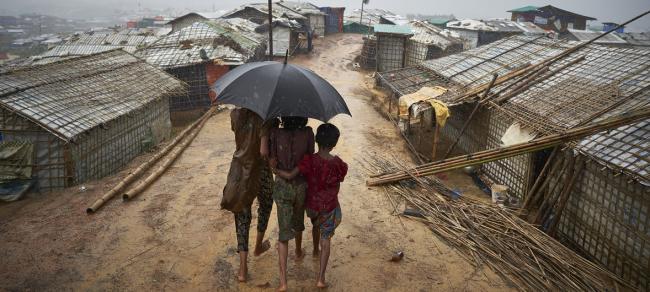
UN migration agency: young Rohingya girls, largest group of trafficking victims in camps
New York, Oct 17 (IBNS): More than a year into the crisis in Cox’s Bazar, the number of Rohingya refugees has reached nearly one million, with young girls in Bangladesh refugee camps sold into forced labour accounting for the largest group of trafficking victims, reported the UN Migration Agency (IOM) on Tuesday.
The agency says that families desperate to earn money are frequently sending their daughters to work in dangerous environments.
“There is a very limited number of jobs in the camp and for women there is almost nothing. That’s why I went outside of the camp,” one Rohingya woman working gruelling hours for little pay in the fish-processing industry told IOM.
IOM reports that women and girls lured into forced-labour, account for two-thirds of those receiving the agency’s support in Cox’s Bazar; another 10 percent were victims of sexual exploitation. Men and boys are not exempt, accounting for about a third of refugees forced into labour.
“We are struggling to meet our everyday needs and there is no scope to get any job inside the camp,” said one Rohingya father, who was physically abused and unpaid for his work. “So, we agreed to go outside of the camp to work.”
Despite the often false promises of work and a better life, some victims are unaware of the risks, or so desperate to escape the situation, that no measure is too drastic.
IOM’s head of protection services in Cox’s Bazar, Dina Parmer, explained that sometimes, “sacrificing one family member for the sake of the rest of the family” is the rationale.
IOM counter-trafficking and protection staff have helped nearly 100 people who have escaped trafficking situations and returned to Cox’s Bazar since the crisis began in August, 2017, leading to an exodus of more than 700,000 refugees across the border into Bangladesh, escaping human rights abuses.
The agency has provided physical and mental health assistance, legal counselling, shelters and emergency cash assistance to support survivors, but due to the nature of human trafficking, many victims are reluctant to come forward and are unaccounted for.
According to Parmer, the Rohingya refugee community is extremely vulnerable to human trafficking due to their brutal life experiences, and lack of education wrought by long-term discrimination back home in Myanmar, where they have been an oppressed minority for decades.
IOM and NGO partners are developing creative ways to communicate the dangers of trafficking in the camps, including comic illustrations, street drama and music illustrating real-life stories to spread the message.
UNHCR/David Azia
Support Our Journalism
We cannot do without you.. your contribution supports unbiased journalism
IBNS is not driven by any ism- not wokeism, not racism, not skewed secularism, not hyper right-wing or left liberal ideals, nor by any hardline religious beliefs or hyper nationalism. We want to serve you good old objective news, as they are. We do not judge or preach. We let people decide for themselves. We only try to present factual and well-sourced news.
Support objective journalism for a small contribution.


