


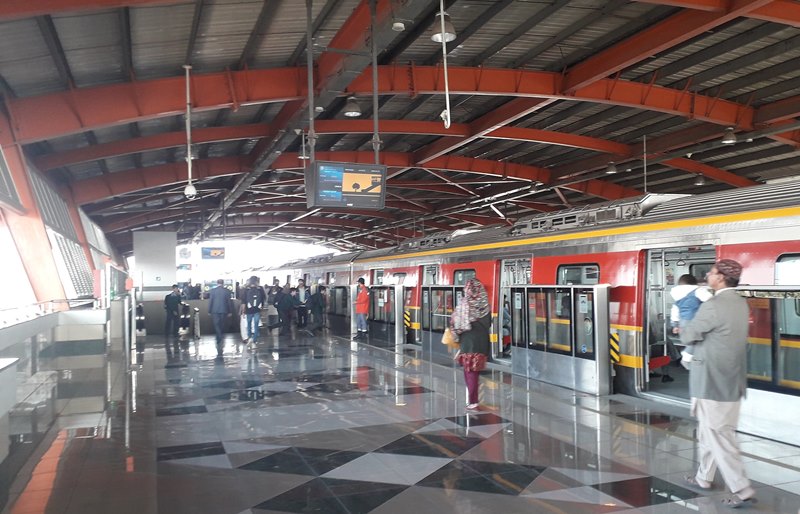
 Pakistan metro
Six years on, Orange line in Lahore continues to be in Chinese stranglehold
Pakistan's much touted metro railway project in the historical city of Lahore, called the Orange Line, seems to have brought many tough lessons for the Pak government.
The 27.1 km long project built at a cost of $2.2 billion by Chinese companies using Chinese loans was completed in 2020.
Financed with a $1.6 billion loan from China's EXIM Bank, the Orange Line Metro Train (OLMT) is jointly constructed and operated by China Railway and Norinco International. Guangzhou Metro Group and Daewoo Pakistan are also involved in the project which took six years to achieve the first run.
The project has often been criticized in Pakistan where opposition parties have argued that the high debt and subsequent public support required by it deprives the poor people of potential welfare benefits.
Besides debt issues, the project was a centre of various controversies ranging from endangering UNESCO heritage sites to complaints over demolishing low- income housing along the route. Environmentalists and citizens have been concerned about the impact of the project on Lahore's historical sites, green spaces, and public health.
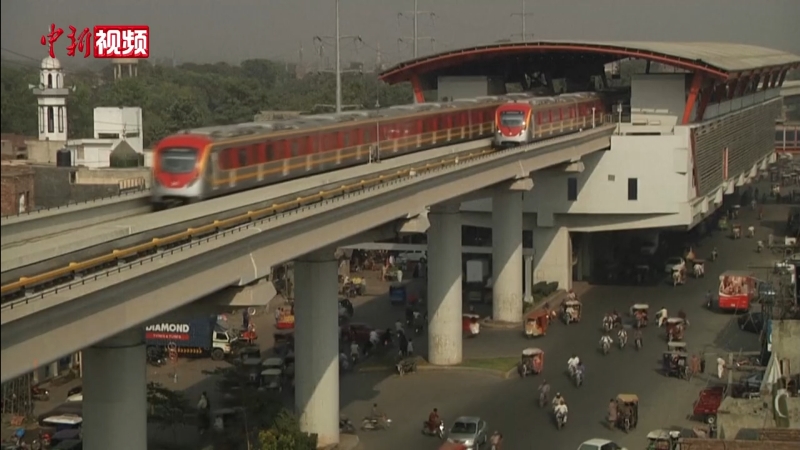
However, for Punjab Mass Transit Authority (PMTA) which operates the line, the real trouble has been building the metro line and handling its operations during the past three years. Long construction delays and rampant disruptions owing to the indifferent attitude of implementing agencies from China have left the authority high and dry on many occasions.
Despite regularly flagging technical glitches and other issues, PMTA gets no respite from the responsible Chinese companies. These days it is seen running after the joint venture (JV) of Norinco International, Guangzhou Metro Group and Daewoo Pakistan for resolution of problems in design of the project.
The authority has complained several times that some of the outdoor fire hydrants are incorrectly installed within the road along the metro stations, which is clearly a design fault. Due to this, several vehicles have crashed into fire hydrants leading to severe human injuries, vehicular
damage and destruction of fire hydrants. In view of the problem, PMTA is requesting to review the design and propose a new plan to relocate fire hydrants at metro stations to resolve the issue. However, response of the JV on the issue has been reclusive till now. While it is not ready to take any responsibility for the defect, it blames the authority for the issue arguing that it could not take proper care of the fire hydrants which led to the damages.
Another persistent issue affecting smooth operations of the metro line is water leakage and draining. Even after three years of running of service, the drainage systems have failed to function properly. National Engineering Services Pakistan Pvt Limited (NESPAK) which is the engineering entity looking after the maintenance has complained to the Chinese companies several times on the issue.
Holding Norinco international responsible for the lapses in construction, NESPAK officials argue the leakage and several unsealed holes may cause mishaps. Further, it is a cause of disruptions in train operations and inconvenience to commuters. Weary of the attitude of Chinese companies, PMTA and NESPAK are now demanding them to undertake a clear bifurcation of responsibilities.
The issues faced by the Pak agencies managing the Orange line demonstrate a clear lack of responsibility owned by the Chinese companies. In general, such problems can be attributed to a lack of long term vision on the part of developing countries when conceiving a project through Chinese aid or loans. While the repayment rates and terms themselves mean a big drag on their revenues for several years, the real impediment comes in the form of project restrictions.
The conditional use of Chinese resources and companies constrain the commercial and operational autonomy, pushing the country away from its socio-economic goals. With a mammoth project burden on its head in the form of CPEC, the case of Pakistan is more pitiable.
Support Our Journalism
We cannot do without you.. your contribution supports unbiased journalism
IBNS is not driven by any ism- not wokeism, not racism, not skewed secularism, not hyper right-wing or left liberal ideals, nor by any hardline religious beliefs or hyper nationalism. We want to serve you good old objective news, as they are. We do not judge or preach. We let people decide for themselves. We only try to present factual and well-sourced news.
Support objective journalism for a small contribution.


