


 Ukraine
Safety at the Zaporizhzhya Nuclear Power Plant in Ukraine is deteriorating following a drone strike, says IAEA
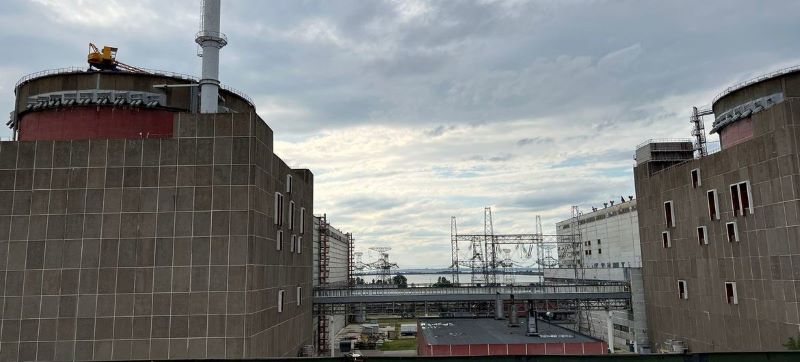
Safety at the Zaporizhzhya Nuclear Power Plant in Ukraine is deteriorating following a drone strike that hit the road near the site’s perimeter, the head of the International Atomic Energy Agency (IAEA) said on Saturday.
Situated in southern Ukraine, Zaporizhzhya is Europe’s largest nuclear plant and has been under Russian control since shortly after the launch of the full-scale invasion in February 2022.
An IAEA team located there was informed that an explosive carried by a drone detonated just outside the plant’s protected area.
Appeal for restraint
The impact site was close to the essential cooling water sprinkler ponds and about 100 metres from the Dniprovska power line, the only remaining 750 kilovolt (kV) line that provides a power supply to the plant.
The IAEA team immediately visited the area and reported that the damage seemed to have been caused by a drone equipped with an explosive payload.
While no casualties or impact to equipment were reported, the road between the nuclear plant’s two main gates was impacted.
“Yet again we see an escalation of the nuclear safety and security dangers facing the Zaporizhzhya Nuclear Power Plant,” said IAEA Director General Rafael Mariano Grossi.
“I remain extremely concerned and reiterate my call for maximum restraint from all sides and for strict observance of the five concrete principles established for the protection of the plant.”
The principles, elaborated in May 2023, state that there should be no attack of any kind against the plant, and it should not be used as a storage or base for heavy weapons.
Furthermore, off-site power to the plant should not be put at risk; all essential structures, systems and components should be protected from attack or sabotage, and no action should be taken to undermine the principles.
Intense military activity
The IAEA team said military activity in the area, including very close to the plant, has been intense over the past week. The experts reported hearing frequent explosions, repetitive heavy machine gun and rifle fire, and artillery, at various distances.
On 10 August, the authorities at Zaporizhzhya plant informed the team that artillery struck the local power and water substation in the nearby city of Enerhodar, where most staff live.
The attack caused the failure of two transformers, leading to a citywide power outage. As a result, water had to be supplied using diesel generators. Power supply was restored the following day.
The IAEA also reported that a significant fire at one of the nuclear plant’s cooling towers earlier this week resulted in considerable damage, although there was no immediate threat to nuclear safety.
A ‘fragile situation’
The UN agency also has a presence at the Khmelnytskyy, Rivne and South Ukraine nuclear power plants, as well as the Chornobyl site. Teams reported frequent air raid alarms and drone attacks this week.
“Nuclear power plants are designed to be resilient against technical or human failures and external events including extreme ones, but they are not built to withstand a direct military attack, and neither are they supposed to, just as with any other energy facility in the world,” said Mr. Grossi.
“This latest attack highlights the vulnerability of such facilities in conflict zones and the need to continue monitoring the fragile situation.”
Developments in Russia
The attack occurred as Ukrainian forces continued their incursion into the Kursk region of Russia, launched earlier this month.
The IAEA recently said that it was monitoring reported military activities taking place in the vicinity of the Kursk Nuclear Power Plant.
Mr. Grossi also continued discussions this week on the recent events in Russia, “including the proximity of military action to an important and operating nuclear power plant.”
He also expressed his readiness to assess the situation, including by making a visit to the plant.
Support Our Journalism
We cannot do without you.. your contribution supports unbiased journalism
IBNS is not driven by any ism- not wokeism, not racism, not skewed secularism, not hyper right-wing or left liberal ideals, nor by any hardline religious beliefs or hyper nationalism. We want to serve you good old objective news, as they are. We do not judge or preach. We let people decide for themselves. We only try to present factual and well-sourced news.
Support objective journalism for a small contribution.


