


Reconciliation helps ‘repair fractures’, enable lasting peace, Security Council hears
New York/IBNS: The UN Security Council this Tuesday has been debating what one activist labeled “the toughest and arguably most important part of the peace-building cycle”: reconciliation.
As UN Secretary-General António Guterres told the gathering, reconciliation processes have played a crucial role in resolving ethnic, religious and political differences in places such as Cambodia, Rwanda, and Northern Ireland, enabling periods of sustained peace.
“Reconciliation helps to repair fractures caused by an absence of trust between state and people, when institutions and individuals acknowledge their role in past crimes, and both victims and perpetrators muster the courage to face the truth. It is a process through which societies can move from a divided past to a shared future,” he said.
Inclusion comes first
Though vital, the UN chief believes reconciliation processes must evolve to be broader, deeper and more inclusive to keep pace with the changing nature of conflict.
They must first be based in the communities and societies affected by conflict, and involve participation from all sectors, including women, religious leaders and young people.
Ilwad Elman from Somalia, an advisor to the UN Secretary-General, underlined the importance of inclusion.
As a programme director for a peace centre named after her late father, who was assassinated in 1996, she welcomed the Council’s debate on what she described as “the toughest and arguably most important part of the peace-building cycle”.
“We know a reconciliation process that almost exclusively involves political parties, with voters left out of the talks, will most likely not succeed”, she said.
“We know that to achieve true reconciliation, then the process must embrace a long-term nationwide solution and the most urgent task is often rebuilding public trust in the institutions: formal and informal.”
The United Kingdom has long advocated for faith leaders to be part of the solution, said Foreign Minister Lord Ahmad of Wimbledon, who chaired the meeting.
“In a world where more than three-quarters of people say directly their faith is important to them, there can be very little doubt that faith leaders have the ability to influence individuals and communities in a way governments simply cannot”, he stated.
No reconciliation without justice
The UN Secretary-General also stressed that there cannot be reconciliation without justice. He highlighted examples of countries such as Guatemala, Sierra Leone and Timor-Leste, which implemented truth and reconciliation commissions following conflict.
He added that reconciliation cannot be a substitute for accountability or pave the way for amnesties for serious crimes under international law.
“And while rendering justice, successful reconciliation mechanisms must advance equality and human rights – even when these did not exist prior to conflict. Human rights violations impact women differently. Transitional justice must be transformative justice that addresses gender imbalances, is rooted in local realities and based on broad consultation,” he said.
But with many societies divided along ethnic, racial, religious and even economic lines, perhaps reconciliation needs to occur before conflict breaks out, according to Alpaslan Ozerdem, Dean of the School for Conflict Analysis and Resolution at George Mason University in the United States.
He called for people everywhere to fight against prejudice and stereotyping.
“We need to support peace and reconciliation at the every day level,” he said. “Our activities as politicians, diplomats, civil society workers, academics, media and the private sector should engender trust, compromise and cooperation.”
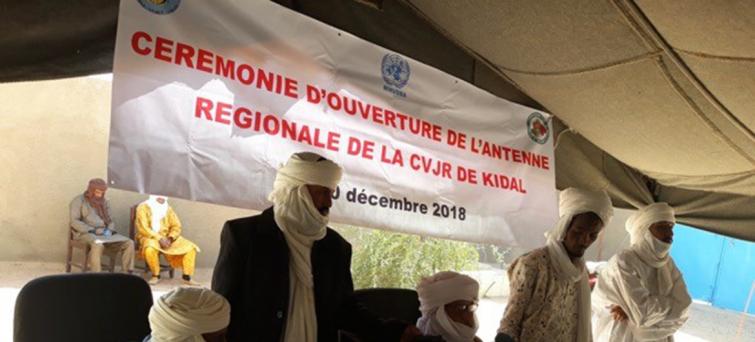
Photo captiona nd credit:
MINUSMA
Opening of an antenna of the Truth, Justice and Reconciliation Commission (CVJR) in Kidal, Mali
Support Our Journalism
We cannot do without you.. your contribution supports unbiased journalism
IBNS is not driven by any ism- not wokeism, not racism, not skewed secularism, not hyper right-wing or left liberal ideals, nor by any hardline religious beliefs or hyper nationalism. We want to serve you good old objective news, as they are. We do not judge or preach. We let people decide for themselves. We only try to present factual and well-sourced news.
Support objective journalism for a small contribution.


