


Promote tolerance, respect diversity, UN chief urges ahead of International Day against racial discrimination
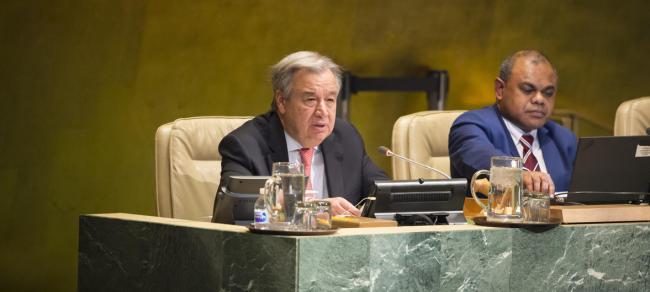
New York, Mar 21 (JEN): People worldwide are being encouraged by United Nations Secretary-General António Guterres to think about how they can better promote tolerance, inclusion and respect for diversity.
The UN chief made the appeal in a speech to the General Assembly in New York on Tuesday, ahead of the International Day for the Elimination of Racial Discrimination.
“It is time all nations and all people live up to the words of the Universal Declaration of Human Rights, which recognizes the inherent dignity and equal and inalienable rights of all members of the human race,” he stated.
Guterres said while there has been progress since the Declaration’s adoption 70 years ago – for example, in the advancement of the rights of women, children, indigenous people and persons with disabilities – there is still far to go in ending discriminatory attitudes, actions and practices.
He listed pressing issues such as gender inequality; the “alarming rise” in xenophobia, racism and intolerance, and a resurgence in far-right political parties and neo-Nazi viewpoints.
Refugees and migrants are also being denied their rights, in addition to being falsely vilified as threats to the societies they seek to join, he continued.
“So, on this International Day, let us all consider how we can better promote tolerance, inclusion and respect for diversity in all nations and among all communities,” the UN chief said.
“Let us work to eliminate messages of hatred – the concept of ‘us’ and ‘them’; the false attitude that we can accept some and reject and exclude others simply for how they look, where they worship or who they love.”
Like the Secretary-General, the UN High Commissioner for Human Rights also looked to the landmark Declaration in his address to the gathering.
Zeid Ra’ad Al Hussein highlighted how discrimination against individuals affects society as a whole.
“The Universal Declaration of Human Rights warns very clearly that if rights are not protected, conflict may follow,” he said.
“Experience has repeatedly demonstrated that discrimination, intolerance, prejudice and scapegoating not only lead to disastrous splintering within societies, endangering national cohesion; they also frequently generate threats to regional peace and lead to a conflict.”
The International Day for the Elimination of Racial Discrimination is observed annually on 21 March.
It commemorates the lives of 69 people killed during a peaceful demonstration in Sharpeville, South Africa, on that day in 1960.
They were among thousands protesting laws that required black citizens to carry a type of internal passport known as a passbook which restricted their movements: a manifestation of the then apartheid system which upheld racial segregation.
As the UN chief pointed out, apartheid “was ultimately – and thankfully – consigned to history” after Nelson Mandela was released from prison and later ascended to the presidency.
Mandela, who died in 2013, was the first democratically-elected president of South Africa and the country’s first black head of state.
While the UN observance provides an opportunity to reaffirm rejection of racism, xenophobia and intolerance, Mr Guterres was saddened that these attitudes persist in countries and among communities around the world.
“A stark and tragic example lies in the egregious treatment of Rohingya Muslims in Myanmar,” he said, referring to the ethnic minority community whose members have been fleeing to Bangladesh by the thousands to escape persecution.
Support Our Journalism
We cannot do without you.. your contribution supports unbiased journalism
IBNS is not driven by any ism- not wokeism, not racism, not skewed secularism, not hyper right-wing or left liberal ideals, nor by any hardline religious beliefs or hyper nationalism. We want to serve you good old objective news, as they are. We do not judge or preach. We let people decide for themselves. We only try to present factual and well-sourced news.
Support objective journalism for a small contribution.


