


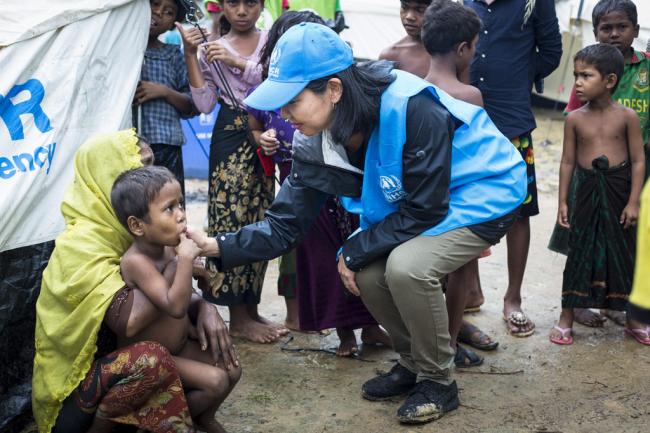
One-third of Rohingya refugee families in Bangladesh vulnerable, UN agency finds
New York, Nov 8(Just Earth News): The innovative data collection technology employed by the United Nations refugee agency for the first stage of Rohingya family counting in Bangladesh has revealed a worrying statistic: one-third of the refugee population is vulnerable.
“In an innovative and revealing family counting exercise, UNHCR [the Office of the UN High Commissioner for Refugees] teams found that one-third of the families are vulnerable,” Duniya Aslam Khan, UNHCR spokesperson told reporters at the regular press briefing in Geneva.
Khan said that “14 per cent are single mothers holding their families together with little support in harsh camp conditions. Others are struggling with serious health problems or disabilities.”
There is also a high proportion of elderly people at risk, unaccompanied and separated children – some of them taking care of younger siblings. Children and women have made up more than half of the total population.
The individual biometric registration exercise, conducted by UNHCR and Bangladesh’s Refugee Relief and Repatriation Commission (RRRC), took place in the Kutupalong camp, makeshift and extension areas and Balukhali makeshift areas and is now extending to further south.
More than 100 UNHCR-hired enumerators have so far gathered data on 120,284 families comprising 517,643 refugees.
This emergency registration was made successful thanks to the new data collecting technology.
The geo-tagged data collection device was designed to use GPS even without network coverage, making data consolidation and analysis more efficient.
The barcoded RRRC Family Counting Card has also given a shape to Rohingya refugees living in Bangladesh in terms of demography and location.
“Because the refugees are still on the move and site zoning is still in progress, the enumerators visit their shelters individually, meaning that refugees do not have to queue to be counted,” Khan explained.
Photo: UNHCR/Roger Arnold
Source: www.justearthnews.com
Support Our Journalism
We cannot do without you.. your contribution supports unbiased journalism
IBNS is not driven by any ism- not wokeism, not racism, not skewed secularism, not hyper right-wing or left liberal ideals, nor by any hardline religious beliefs or hyper nationalism. We want to serve you good old objective news, as they are. We do not judge or preach. We let people decide for themselves. We only try to present factual and well-sourced news.
Support objective journalism for a small contribution.


