


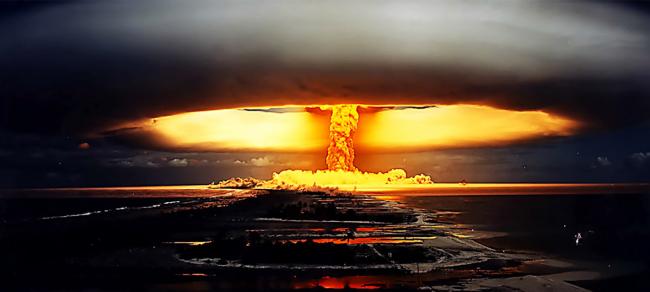
Nuclear test ban treaty critical to global collective security – UN chief
New York, Aug30 (IBNS): Every effort should be made to bring a global treaty into force that prevents more countries from developing nuclear weapons, UN Secretary-General António Guterres has said.
His appeal came in a message for the International Day Against Nuclear Tests, observed annually on 29 August.
“The history of nuclear testing is one of suffering, with the victims of more than 2,000 nuclear tests often from the most vulnerable communities around of the world,” Mr. Guterres said.
“The devastating consequences – which were not confined by international borders -- encompassed impacts on the environment, health, food security and economic development.”
The UN has been pressing for the Comprehensive Nuclear-Test-Ban-Treaty (CTBT) to become law.
The treaty prohibits nuclear explosions anywhere – whether on the Earth’s surface, in the atmosphere, underwater or underground.
It also makes it difficult for countries to develop nuclear bombs for the first time, and prevents nations that already possess nuclear technology from developing even more powerful bombs.
More than 180 countries have signed the treaty, most of whom have also ratified it.
However, while nearly universal, the treaty will only enter into force after it is signed and ratified by eight countries with nuclear technology capacity: China, Egypt, India, Iran, Israel, North Korea, Pakistan and the United States.
“The Comprehensive Nuclear-Test-Ban Treaty has an essential role within the nuclear disarmament and non-proliferation regime,” the UN chief said. “It fosters international peace and security by constraining the development of nuclear weapons. Our collective security demands that every effort should be made to bring this essential treaty into force.”
Lassina Zerbo, Executive Secretary of the UN commission which promotes the treaty, known as the CTBTO, also called on the international community to “take the final steps” to ensure its entry into force.
“As long as the Treaty is not in force, the established international norm against nuclear testing and the global verification system that has been developed over the past two decades are at risk. I urge the last eight countries to ratify the Treaty and I appeal to others to renew their efforts in supporting it,” he said, also in a message to mark the International Day.
Zerbo said his conviction regarding the role the treaty can play on the Korean Peninsula was strengthened following a visit to the region last week.
The CBTO is hosting a meeting in Kazakhstan this week, which brings together international experts and young people to look at key issues surrounding denuclearization.
“The significance of being in Kazakhstan on 29 August where nuclear testing has left a poisonous legacy is immense,” Zerbo added, recalling that the date also commemorates the 1991 shutdown of the Semipalatinsk test site, where the Soviet Union undertook what he called “one of the most extensive nuclear test programmes in history.”
“For Kazakhstan, it was very important to share its own experience in having the nuclear tests conducted in its territory,” said Ambassador Kairat Umarov, the Permanent Representative of Kazakhstan to the UN, emphasizing that nuclear weapons are not only destructive when they are used, but also that their harmful effects continue to linger on, devastating people’s lives and the environment where they are used.
“If we talk in figures, the after effects of the nuclear tests in the air, on the ground and under the ground, it is like spraying 300 kilograms of weapons-grade plutonium over 18,000 square kilometers […] a huge territory that is rendered useless,” he explained.
CTBTO
Support Our Journalism
We cannot do without you.. your contribution supports unbiased journalism
IBNS is not driven by any ism- not wokeism, not racism, not skewed secularism, not hyper right-wing or left liberal ideals, nor by any hardline religious beliefs or hyper nationalism. We want to serve you good old objective news, as they are. We do not judge or preach. We let people decide for themselves. We only try to present factual and well-sourced news.
Support objective journalism for a small contribution.


