


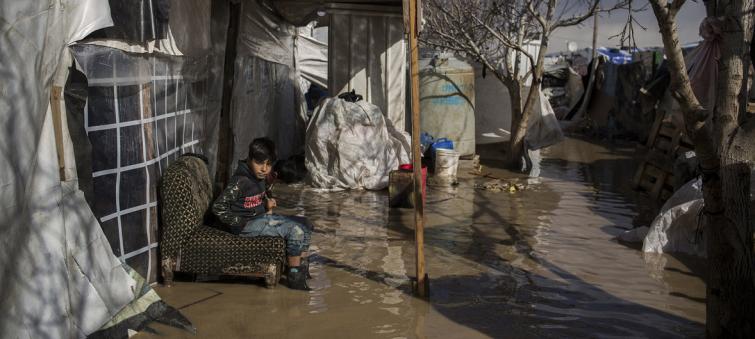
Not enough resettlement solutions for refugees worldwide, says UN
New York, Feb 20 (IBNS): Despite record numbers of people forcibly displaced across borders, with 1.2 million in need of a new permanent place to call home last year, the UN refugee agency (UNHCR) released new data on Tuesday showing that only 55,700 of them – 4.7 per cent – were able to be resettled in 2018.
Resettlement, which involves the relocation of refugees from a country of asylum to a country that has agreed to admit them and grant them permanent settlement, is available only to a fraction of the world’s refugees. Typically, less than one per cent of the 20 million refugees under UNHCR’s mandate worldwide are ever resettled.
The data covers specifically UNHCR-facilitated resettlements and shows that the highest numbers of resettlement departures originated in major refugee-hosting countries, including Lebanon (9,800), Turkey (9,000), Jordan (5,100) and Uganda (4,000).
Out of 81,310 requests for resettlement made by UNHCR in 2018, the largest number were for people from Syria (28,200), the Democratic Republic of the Congo (21,800), Eritrea (4,300) and Afghanistan (4,000).
More than two thirds of requests for resettlement were for survivors of violence and torture, people with legal and physical protection needs, and women and girls at risk. More than half of all resettlement submissions in 2018 were for children.
This year, it is estimated that 1.4 million refugees who are currently residing in 65 hosting countries worldwide, will need to be resettled. The vast majority are Syrian refugees (43 per cent), most of whom are currently hosted in countries across the Middle East and Turkey, and refugees hosted in asylum and transit countries along the Central Mediterranean route (22 per cent), where movements towards Europe continue to take a devastating toll on human life.
UNHCR explained in its statement that resettlement remains a “life-saving tool” as it is meant to ensure the protection of those most at risk. It is an “instrument of protection, and a tangible` mechanism for governments and communities across the world to share responsibility for responding to forced displacement crises”.
Resettlement and other complementary pathways for admission, is a key objective of the Global Compact on Refugees, adopted last December, to help reduce the impact of large refugee situations on host countries. The document calls for Member States to offer more resettlement solutions, by expanding existing programmes or establishing new ones.
The UN refugee agency is working with governments and other entities, to develop a three-year strategy on “Resettlement and Complementary Pathways” to help increase the pool of resettlement places, encourage more countries to participate in global resettlement efforts, and increase access to complementary pathways for refugees.
Image Credit: UNHCR/Diego Ibarra Sánchez
Support Our Journalism
We cannot do without you.. your contribution supports unbiased journalism
IBNS is not driven by any ism- not wokeism, not racism, not skewed secularism, not hyper right-wing or left liberal ideals, nor by any hardline religious beliefs or hyper nationalism. We want to serve you good old objective news, as they are. We do not judge or preach. We let people decide for themselves. We only try to present factual and well-sourced news.
Support objective journalism for a small contribution.


