


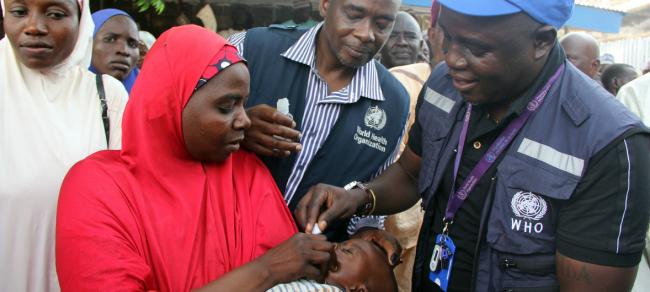
Nigeria inundated by floods; UN steps up disease prevention efforts
New York, Oct 5 (IBNS): With over 826,000 people affected by heavy flooding affecting most of Nigeria, humanitarian agencies continue to step up efforts to provide life-saving assistance, especially basic medical care, which is essential to prevent disastrous epidemics.
Nigeria’s two main rivers, the Niger and the Benue, burst their banks after heavy rain began falling in August, and the country has been experiencing large-scale floods.
The disaster is now affecting 12 out of 36 states according to the National Emergency Management Agency, with 176,300 people displaced, more than 150,000 hectares of farmland inundated, 17,800 houses washed away, and 321 roads and bridges destroyed.
As of Monday, the floods had claimed about 200 lives. A state of national disaster has been declared in the four most-affected states: Kogi, Niger, Anambra and Delta.
The United Nations and its partners are carrying out rapid assessments and scaling up support to the Government’s emergency response. In particular, the World Health Organization (WHO) has deployed experts to strengthen surveillance and early warning systems and is working to ensure that essential drugs are available in newly-created camps for displaced families.
“In addition to the immediate destructions and loss of lives, floods can severely affect the health of the affected population, even after the water levels have receded,” said the head of WHO in Nigeria, Dr. Wondimagegnehu Alemu, in a statementreleased on Thursday.
Floods and their consequences – including a lack of drinkable water, shelter, and overflowing sanitation systems – can easily lead to the spread of communicable and water-borne diseases, such as cholera and malaria. In addition, access to healthcare and essential drugs can be difficult if health facilities are damaged.
“We can efficiently mitigate these risks if they are properly assessed and if disaster response measures are in place,” Dr. Alemu explained.
To facilitate the mobilization of resources for the response to the flooding, the International Federation of Red Cross and Red Crescent Societies (IFRC) launched an emergency appeal, seeking close to US$5.5 million. The funds are to support 300,000 of the most vulnerable flood-affected people for the next nine months, with shelter and basic household items; protection and livelihoods assistance, including through cash transfers; health care provision; water and sanitation supplies.
The country’s north-east is in the grip of one of the world’s worst humanitarian crises due to conflict, and already suffering various cholera outbreaks in the states of Borno, Adamawa and Yobe, making it crucial for humanitarian partners to effectively monitor and control the effects of the flooding in the rest of the country.
In the coming days, the UN humanitarian chief, Mark Lowcock, and the head of the UN Development Programme, Achim Steiner, will visit the region, spending Friday and Saturday in Nigeria, and then moving on to neighbouring Chad.
WHO/Chima Onuekwe
Support Our Journalism
We cannot do without you.. your contribution supports unbiased journalism
IBNS is not driven by any ism- not wokeism, not racism, not skewed secularism, not hyper right-wing or left liberal ideals, nor by any hardline religious beliefs or hyper nationalism. We want to serve you good old objective news, as they are. We do not judge or preach. We let people decide for themselves. We only try to present factual and well-sourced news.
Support objective journalism for a small contribution.


