


Military escalation will have ‘serious consequences’ for Yemeni civilians, warns UN Special Envoy
New York, June 14 (IBNS): An attempt by a Saudi-led military coalition to take control of the Yemeni port of Hodeida from opposition Houthi forces “will have serious consequences” on an already “dire” situation for millions of civilians, the UN Special Envoy for Yemen said on Wednesday.
In a statement issued amid reports that a major air and ground assault is now underway against the key Red Sea port city, Martin Griffiths also warned that it “will have an impact” on his efforts to bring the warring parties to the negotiating table.
Reiterating the UN’s “strong commitment” to reaching a political solution to the conflict, the Special Envoy said that “every opportunity” was being employed to avoid a military confrontation.
He added that he and his team were in “constant contact with all the parties involved” to ensure that all of their concerns were addressed, on a political, humanitarian and security level.
“I call on the parties to engage constructively with our efforts to spare Hodeidah any military confrontation,” Mr Griffiths’ statement said. “I also call on the parties to exercise restraint and to give peace a chance.”
Since fighting escalated in the Arabian peninsula State in March 2015, thousands of civilians have been killed and the vast majority of the population – some 22 million people – have become dependent on humanitarian assistance.
The attack on Hodeida is significant since it is a key access point for aid and other everyday items for ordinary Yemen.
Speaking in Geneva in response to reports that fighting had intensified around Hodeida, UN Refugee Agency chief Filippo Grandi said that it would make aid access “more difficult”.
“It’s not just the humanitarian access which has been on and off, but is also more important, access of goods through trade. Fuel, food, medicines, at least these three big areas. And I think that fighting will make it more difficult for that access to happen.”
UNHCR had already taken the decision to pull out international staff ahead of the attack, Mr Grandi said, but not national staff, who he said were left “more exposed”.
The UN refugee chief added that it was a “miracle” that more aid personnel had not become victims of the violence that claimed the life of a Lebanese national from the International Committee of the Red Cross (ICRC) in the city of Taiz, south of Hodeida, in April.
Even before the current conflict, Yemen was one of the poorest countries in the world and imports provided almost all of its daily requirements.
Across the country, the fighting between forces loyal to President Abd Rabbuh Mansour Hadi supported by the Saudi coalition and Houthi rebels has left fewer than half of the country’s health facilities operational.
Basic medical needs cannot be met, leaving ordinary Yemenis vulnerable to preventable diseases, including cholera, which affected more than one million people last year.
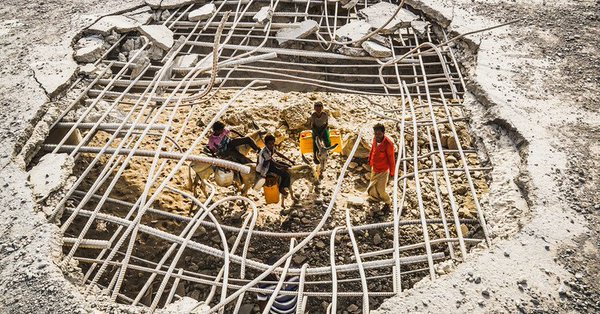
OCHA/Giles Clarke
Support Our Journalism
We cannot do without you.. your contribution supports unbiased journalism
IBNS is not driven by any ism- not wokeism, not racism, not skewed secularism, not hyper right-wing or left liberal ideals, nor by any hardline religious beliefs or hyper nationalism. We want to serve you good old objective news, as they are. We do not judge or preach. We let people decide for themselves. We only try to present factual and well-sourced news.
Support objective journalism for a small contribution.


