


Help build vulnerable island states’ resilience to extreme weather, urges senior UN official
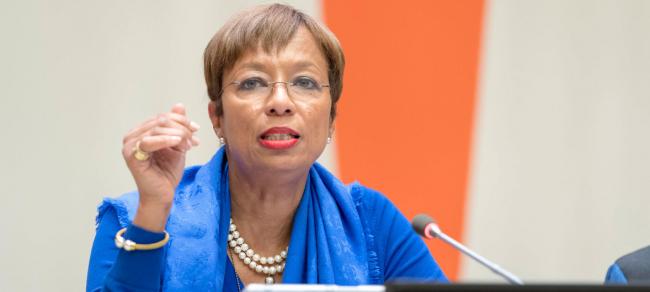
New York, Nov 14 (IBNS): With Small Island Developing States (SIDS) bearing the brunt of economic losses from climate change, making them more resilient to extreme weather events must be a priority, said Inga Rhonda King, President of the UN Economic and Social Council (ECOSOC), speaking at UN Headquarters in New York on Tuesday.
King was speaking alongside Louis Alfonso De Alba, Special Envoy for the UN 2019 Climate Summit, and a number of other senior UN officials at the meeting, a follow up to an event in October 2017 convened in the aftermath of devastating hurricanes that had swept over the islands of the eastern Caribbean a month earlier, prompting UN Secretary-General António Guterres to describe the island of Barbuda as “paradise turned into hell.”
Referring to the recent special report of the Intergovernmental Panel on Climate Change (IPCC), de Alba warned that the climate situation is not going to improve: “On the contrary it may worsen very quickly. And that’s why building resilience is an urgent matter, but Small Island Developing States find themselves in a very difficult situation, and that’s why we need to address these issues.”
Greater investment in disaster risk reduction, recovery and reconstruction efforts and financing were identified as important steps in helping affected and vulnerable countries to recover and adapt to the consequences of climate change.
With regards to the issue of financing, De Alba welcomed the mobilization of over $1.6 billion in reconstruction funds from across the Caribbean, with the support of the UN, but expressed concern that at least $1 billion in loans and debt relief need to be taken into account: he urged the international community to recognize the specific challenges faced by the region.
King said that, between 1998 and 2017, the 10 countries most severely financially affected by climate-related disasters, in terms of the percentage of their gross domestic product, were small Caribbean countries or territories: Dominica’s losses after Hurricane Maria were equivalent to 259% of its GDP.
De Alba reminded the delegates that, last year, thousands were made homeless, and key infrastructure for transportation, water, health, tourism, and education were devastated: “Between 70 and 95 percent of houses were damaged in Anguilla, the Bahamas, the Turks and Caicos Islands, British Virgin Islands (BVI), Barbuda and Dominica,” he said.
Tuesday’s meeting, said King, was an opportunity to make the case for vulnerability to be used as a criterion when deciding when countries get access to financing.
Looking ahead to 2019, King noted several key events of particular importance to Small Island Developing States, including the High-Level Political Forum on Sustainable Development (HLPF), the Climate Summit of the Secretary-General, the SDG Summit and the high-level mid-term review of the SIDS Accelerated Modalities of Action (SAMOA) Pathway.
Support Our Journalism
We cannot do without you.. your contribution supports unbiased journalism
IBNS is not driven by any ism- not wokeism, not racism, not skewed secularism, not hyper right-wing or left liberal ideals, nor by any hardline religious beliefs or hyper nationalism. We want to serve you good old objective news, as they are. We do not judge or preach. We let people decide for themselves. We only try to present factual and well-sourced news.
Support objective journalism for a small contribution.


