


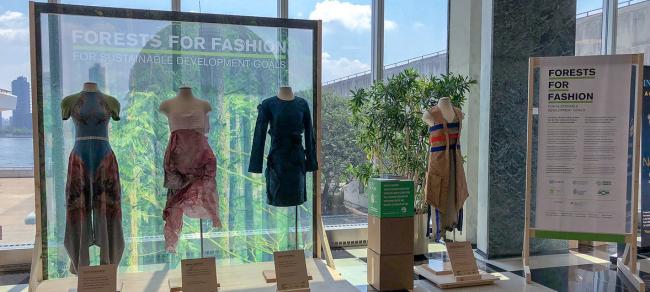
Dress the world in wood, UN says in its ‘Forests for Fashion’ initiative
New York, July 17 (IBNS): The fashion industry is valued upward of 2.5 trillion dollars, and employs some 75 million people globally – so it makes good sense to shift textile production from fossil fuel-based synthetic fibers to renewable, biodegradable textiles, made from wood, according to a new United Nations initiative that aims to make forests literally more fashionable.
The United Nations Economic Commission for Europe (ECE)-FAO’s (Food and Agriculture Organization) “Forests for Fashion” initiative, links forest-based materials from sustainably managed forests, with the world of fashion.
“Sustainability of a society is both an individual and a collective responsibility,” said UN Development Programme (UNDP) Goodwill Ambassador Michelle Yeoh, at UN headquarters on Monday.
“The fashion industry is responsible for producing 20 per cent of global waste water and 10 per cent of the global carbon emissions – more than the emissions of all international flights and maritime shipping combined,” said the star of the movie Crouching Tiger, Hidden Dragon.
In addition, the textiles industry has recently been identified as a major polluter, with estimates of around half a million tonnes of plastic microfibers ending up in the world’s oceans as polyester, nylon or acrylic are washed each year.
“Fashion is often a synonym of dangerous working conditions, unsafe processes and hazardous substances used in production,” she continued, citing the cruel abuses of modern slavery and child labour.
Although the 2030 Agenda for Sustainable Development and the Sustainable Development Goals (SDGs) are an ambitious blueprint for governments, Ms. Yeoh stressed that everyone must make a conscious choice to change habits and plan for the future.
“Today we count around 3.2 billion people in the global middle class,” she said. “By 2030, this number will rise to about 5.4 billion with the major part of the growth occurring in Asia. The 2.2 billion people entering the global middle class will aspire to a similar lifestyle as we know it today – which includes a similar consumption pattern with respect to clothing.”
A fashion revolution
Calling fashion “a major development challenge,” Yeoh sees clothing as “an essential element for the transition towards sustainable societies.”
While acknowledging the need for governments’ involvement in shifting the fashion industry to in the right direction, she put the main onus on individuals to start the fashion “revolution”.
“Many of us would also think that forests are best left untouched, however is often by adding value to their products that we can best protect them, and in many cases restoration efforts can be coupled with productive forests,” she attested.
Moreover, forests can create productive ecosystems, to support local and rural communities. According to the UNDP envoy, ‘forest fibers are already a reality and textile businesses are growing or buying large forest extensions.”
“New fibers are highly sustainable, their carbon and ecological footprints are low, and there are different fast-growing species suitable for different places and climates,” she indicated.
“Let’s face it,” concluded Ms. Yeoh, “changing the production and consumption patterns of the fashion industry will have a domino effect on many aspects of development and provide a visible and meaningful contribution to the achievement of the 2030 Agenda.”
UN News/Fatima E. Mendez
Support Our Journalism
We cannot do without you.. your contribution supports unbiased journalism
IBNS is not driven by any ism- not wokeism, not racism, not skewed secularism, not hyper right-wing or left liberal ideals, nor by any hardline religious beliefs or hyper nationalism. We want to serve you good old objective news, as they are. We do not judge or preach. We let people decide for themselves. We only try to present factual and well-sourced news.
Support objective journalism for a small contribution.


